

Japan-inspired living: what care does for us
Article content
Japan, the land of the rising sun
At the beginning of October I set off on holiday there, and I had been looking forward to it for a long time.
The aesthetics of this country have fascinated me since childhood: sliding doors, rice paper, textiles and tatami mats. Then there is the craftsmanship, such as paper, ceramics or Japanese knives. Now I finally got to experience it all for myself.
I was also very curious about the culture. Japan is considered orderly, strict and controlled. And I wanted to see whether a lot of ikigai is still lived there, having read Ken Mogi’s book two years ago.
This article combines my discoveries about Japan’s aesthetics, art and culture with my eye as an interior architect. It asks what we can take home with us into our own homes here in Europe, from ikigai to wabi-sabi to Japandi.
One caveat up front: I am writing about traditional Japan and about what I experienced there. Modern Japan, and the younger generation in particular, often live very differently. There too you find constant work stress, a veritable flood of plastic and, in places, very cramped living conditions. And yet beneath all that there are attitudes that are still lived today and that simply do you good.
The entrance: the threshold to your home
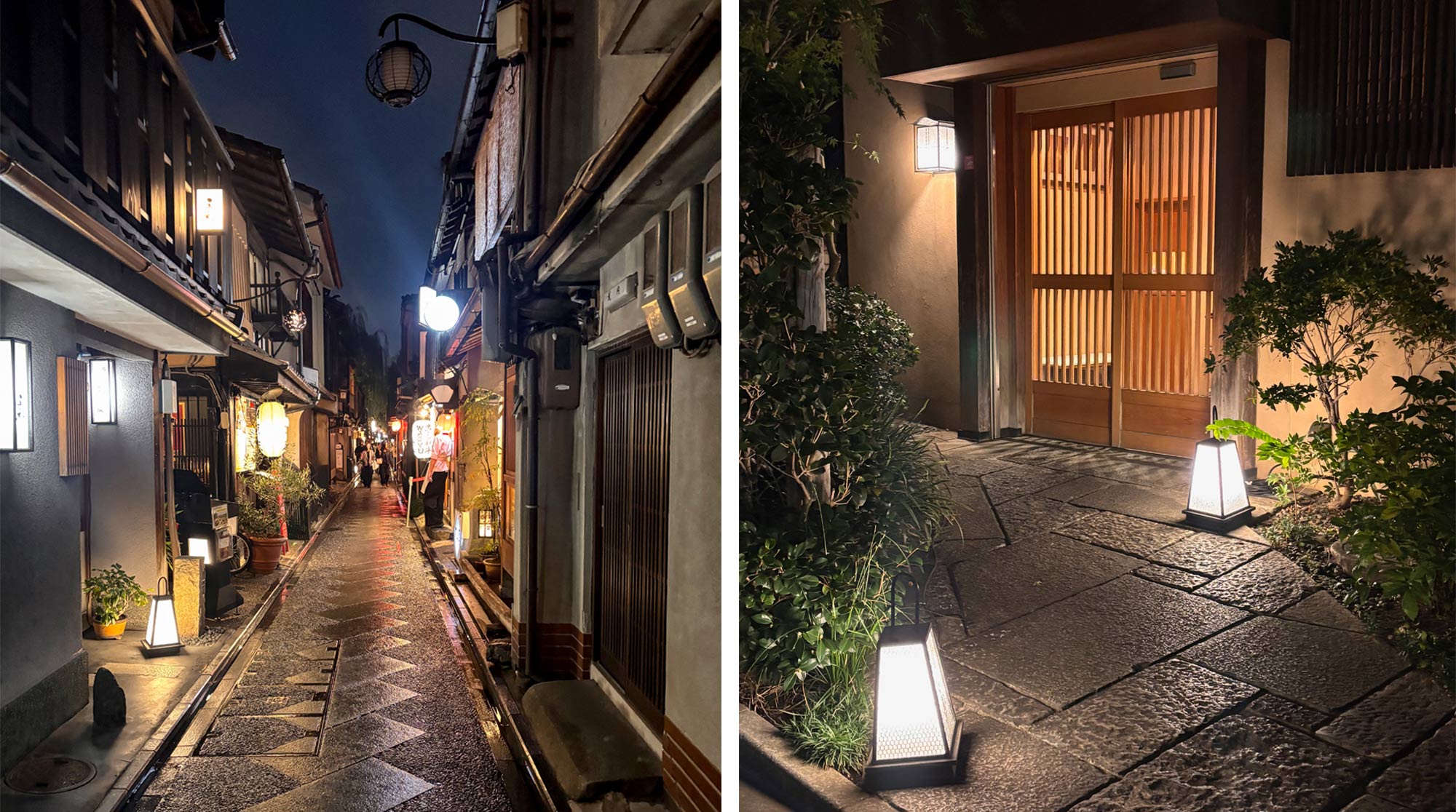
In the small side streets of Kyoto, an architect can hardly stop marvelling. Even the smallest house and the narrowest entrance are a composition. Well-kept front doors with wooden slats or rice paper, here and there a little garden of potted plants, framed by stone figures and lanterns. You sense immediately: this is an important place. The threshold.
Here, we often look for a connection between inside and outside. But that only works if you are surrounded by nature or have a beautiful view. In Japanese cities that is rarely the case; you step out directly onto the street. Perhaps that is exactly why the transition is designed so deliberately.
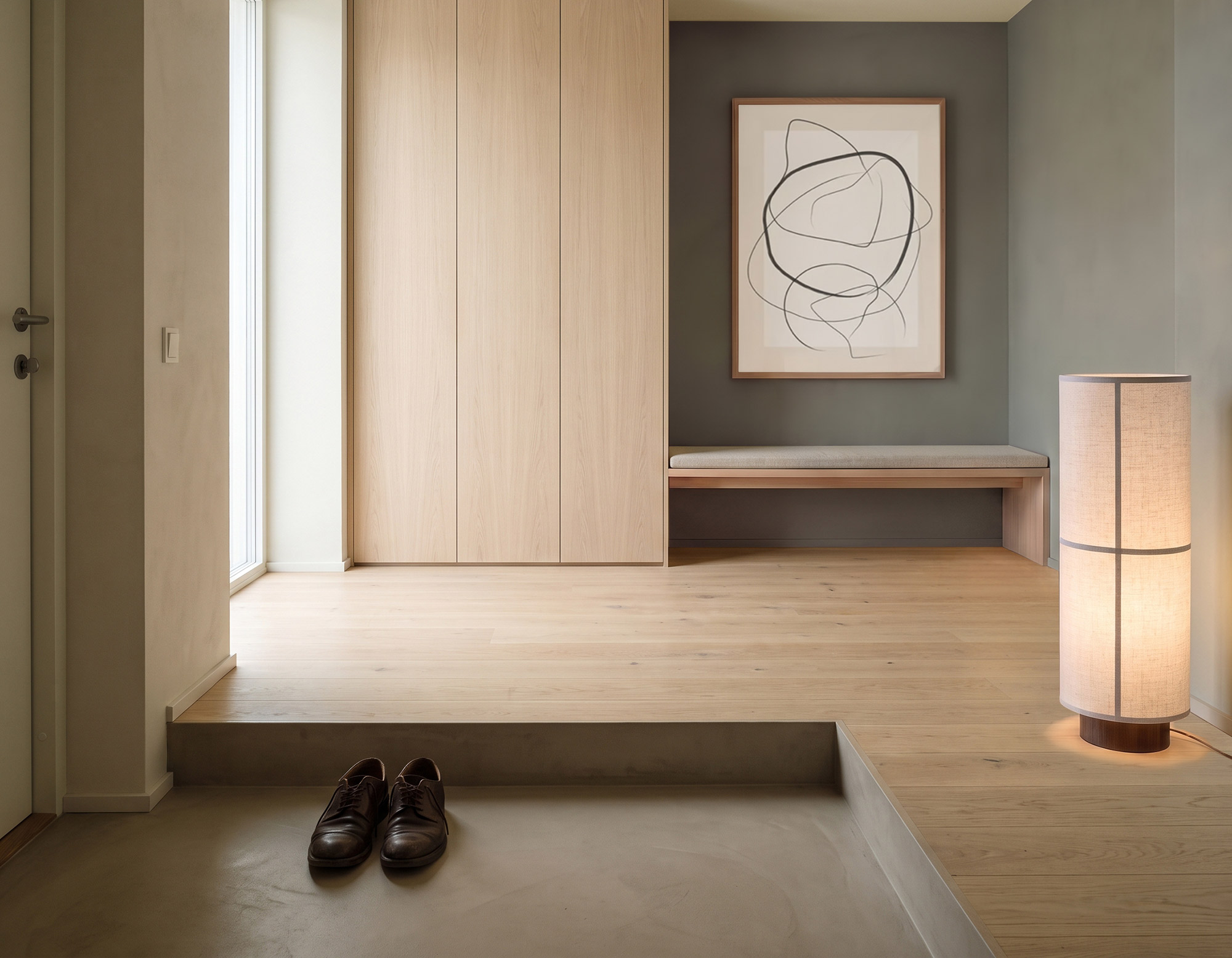
When you enter a house in Japan, you first stand in the genkan. This is a small entrance hall that usually sits a few centimetres lower than the rest of the living space and is often paved with tiles, stone or concrete. This is where you take off your outdoor shoes, and a step marks the move up into the living area. The genkan separates outside from inside, quite literally.
For Interior Architecture, I find the idea of giving the entrance such special treatment absolutely sensible. The act of arriving is highlighted and celebrated. With visual cues we tell body and mind: now I am arriving, now I am home. A small joy that honours the moment and brings us into the present.
By contrast, our entrance area is mostly a purely practical place, without much love for detail. How often do we walk through the door at home while our thoughts are still at work? If we make the threshold tangible and consciously beautiful, we help body and mind switch into a new mode. We can take a great deal from this.
Living in the smallest of spaces
In Japan space is scarce, and many people live in very small spaces. The main room often serves not only as a living room but also as a bedroom. In the evening the futons are taken out of the cupboard, people sleep on tatami mats on the floor, and the next morning everything is put away again. Although things could probably be done differently today, in many places people still do it this way.
For us, that is hardly imaginable. In Switzerland, according to the Federal Statistical Office (as of 2025), we have an average of 46.6 m² of living space per person, so a two-person household has around 90 m² or more. A room that serves only for sleeping is normal, and we would prefer to have a separate room for every activity: a living room, an office, a hobby room. Often because we believe that several activities cannot be accommodated well in one room, sport for example. If the equipment has to be put away every time, at some point you simply stop doing it because it is too much hassle.
The truth lies somewhere in between. What matters is the right setup. If it takes only a little effort, just a few simple steps, and the cues, meaning the visual triggers, are placed correctly, it works very well. I describe how rooms can help to establish good routines in my article «How Interior Design can help to train new habits» .
Ikigai: a reason to get up in the morning
Since we are talking about effort, this is where I have to talk about ikigai. In Japan, effort is not discomfort to be avoided at all costs, but often a sign of pride and appreciation.
In the West, ikigai is mostly known as a diagram of four overlapping circles: what you love, what you are good at, what the world needs and what you get paid for. That is a Western invention and turns ikigai into a grand life purpose that you are supposed to find and put to professional use. Originally the term is more modest. It is composed of iki (life) and gai (value, effect) and means that which makes life worth living. Ken Mogi describes exactly this in his book: the small things in everyday life that give us a reason to get up. The joy of a good coffee, of a ritual, of work you want to do well.
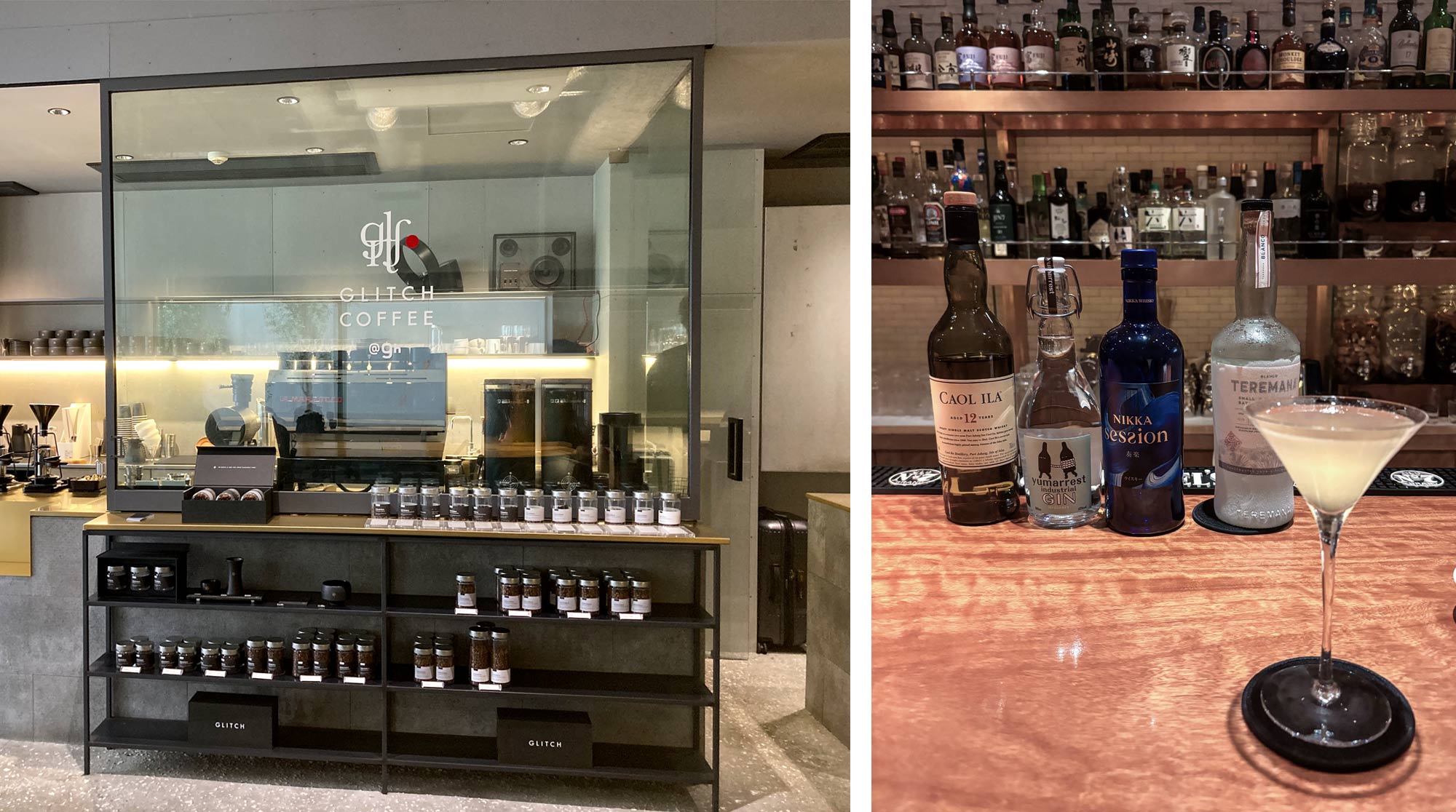
And indeed, I saw a great deal of this in Japan. In Tokyo we wanted to go to Glitch Coffee, a very popular spot of modern coffee culture. At the first location the queue was so absurdly long that we moved on without coffee. The next day we tried a second branch, and even so it took around 40 minutes until it was our turn. That was down to the baristas, who remained completely unaffected by the queue. With total calm they devoted themselves to each guest with their full presence, explained the varieties, asked about taste preferences and let guests take a sniff before setting about the preparation with a skilled, steady hand. Right up to the finished latte art it was a joy to watch, and we have tried a great many coffees around the world. Nobody seemed stressed, nobody tried to speed up. The coffee set the pace, not the queue outside the door.
We experienced the same care in a cocktail bar: you could specify flavour notes (I chose smoky and spicy), and the bartender conjured up an individual creation from them. You could feel the love of detail in every step, from preparation to serving.
Both do their work with care, and they take pride in what they do. I often had the feeling that they devote themselves completely to what is in front of them and, to some extent, block out everything around them, or at least do not let it affect them. The value lies not in doing as much as possible, but in doing well what you do. There is a word for this in Japan: omotenashi. It is best translated as sincere hospitality and care.
For us it is often the other way round. In our Western world we strive for comfort and try to eliminate every last little hurdle: lift instead of stairs, smart lighting control, ever larger walk-in wardrobes, and being lulled by the TV in the evening while the robot vacuum does the work. Many forget what effort does. Effort and exertion create pride and contentment, and effort also anchors us in the present. When everything becomes convenient, this feeling is lost without our noticing. Convenience has a price.
I believe we can bring a little ikigai home if we devote ourselves to our daily rituals with joy and care, for example preparing a coffee or tea. Here too the environment plays a role, just like the genkan when we arrive: whoever designs the place for their rituals consciously makes this time more special and anchors themselves in the here and now. The bathroom can also be such a place for ritual. Onsen culture in Japan is a good example of this.
Onsen: bathing as ritual
Onsen is the name for Japan’s hot springs and the baths that have grown up around them. Bathing there is more than personal hygiene.
In Beppu in the south of Japan, a city known for its hot springs, we visited an onsen institution. The procedure there follows a clear order. First we were bathed in sand, which the hot springs in Beppu warm. Then came the cleansing.
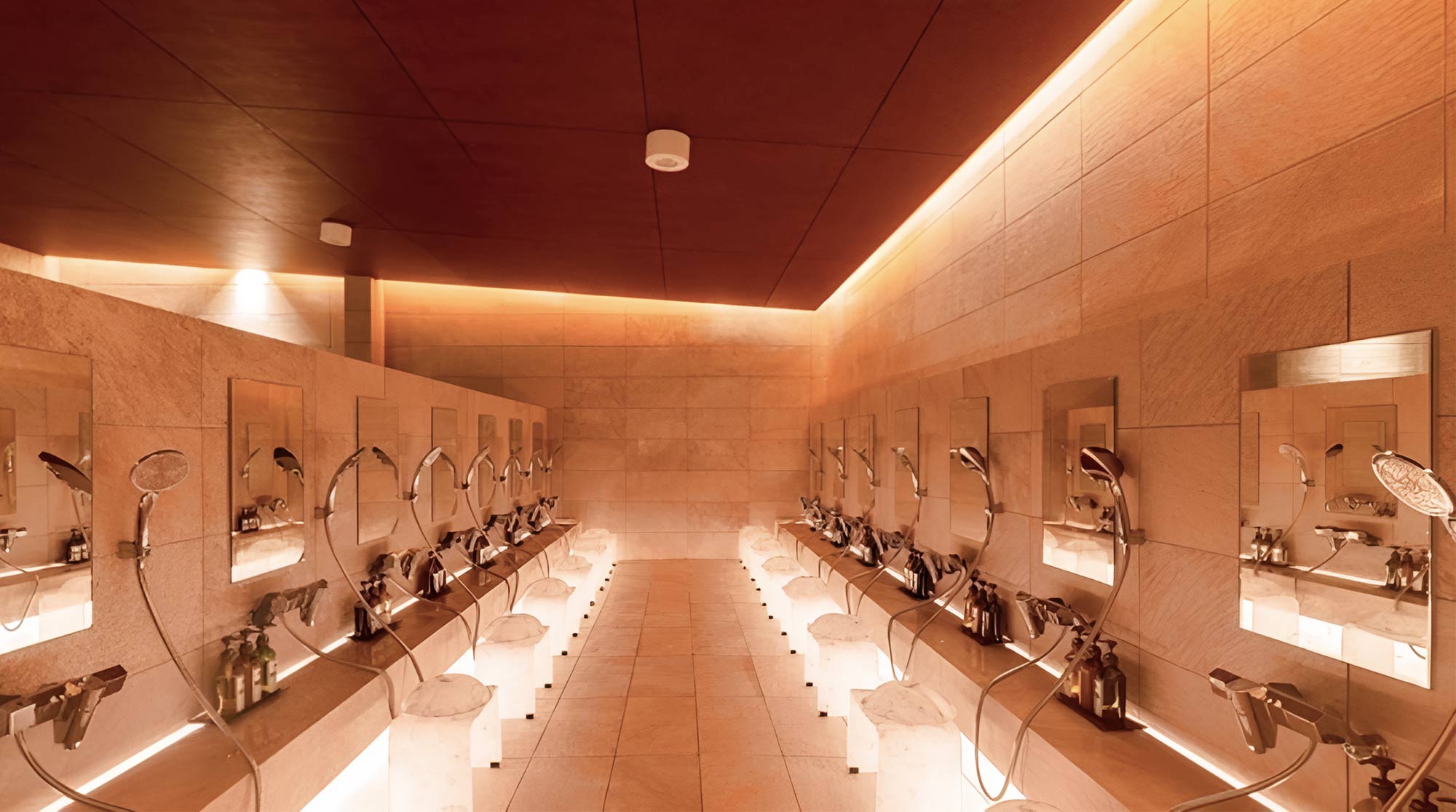
First a short shower to remove the sand. Then you move on to the actual washing room, where you sit on a small stool and wash yourself calmly and thoroughly, armed with a shower hose and a bowl. Only then do you step, clean, into the baths. The water there is for healing.
This too is effort as appreciation, towards your own body, the water and the other bathers. And it has a long tradition. For centuries, people in Japan have travelled to hot springs to recover, often for several days. This is called tōji, the bath cure.
In the onsen everyone is naked and therefore equal. Clothing, status and profession stay in the changing room. In Japanese there is an expression for this, hadaka no tsukiaitsukiai, roughly «naked communion».
In my article «Rethinking Bathroom Design» I already described that a bathroom is much more than a functional space. It is a place of self-care and ritual. If we design it so that it supports our rituals and influences our senses in that direction, it becomes something special. For me, the bathroom is one of the strongest places where we can positively influence our wellbeing.
For this you do not need a huge bathtub. A place to sit, wood and stone as materials, dimmed warm light and «taking your time» change how a bathroom feels.
Wabi-sabi: the beauty of imperfection
I felt wabi-sabi most strongly at Fushimi Inari. On the way up the mountain through the many torii gates, you come across moss-covered stone figures, marked by age, with fresh candles burning beside them. This image, and precisely the traces of time, make the place so movingly beautiful and were my personal highlight of the trip.
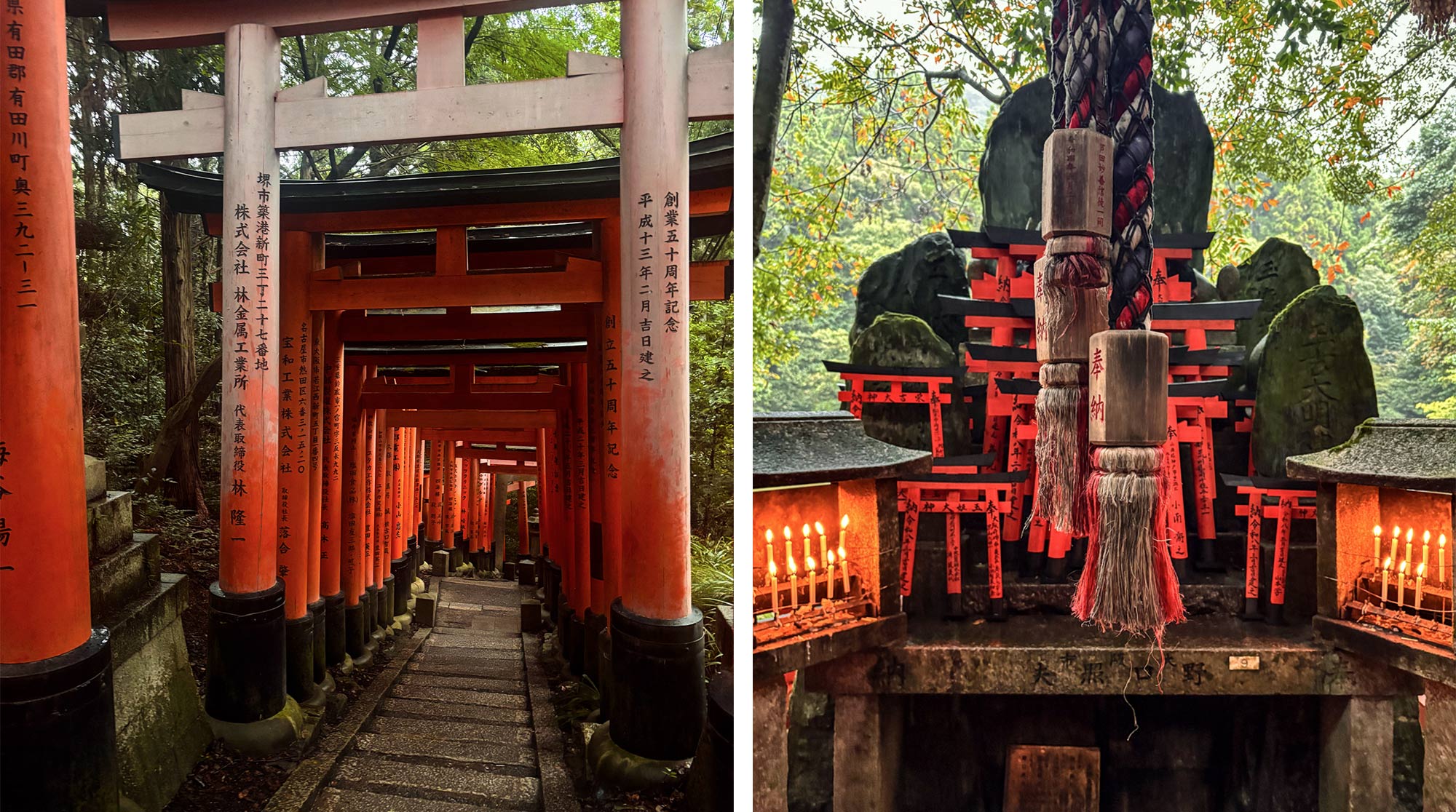
That is wabi-sabi. In itself it is hardly translatable. Wabi stands for simplicity and naturalness, sabi for the patina that things acquire over time. The term is closely linked to the tea ceremony. At its core it says: the imperfect, the transient and the simple may be beautiful, and often are so precisely because of it.
Our Western world, and unfortunately also the young generation in Japan, has a rather poor attitude towards anything that looks old. Be it wrinkles in the face that came from hundreds of hours of laughing joie de vivre, or signs of wear on clothes and furniture: what no longer shines gets replaced. Yet it is often precisely the old things that move us inside. Grandmas and grandpas with their wrinkled faces, the worn-out sneakers that have travelled half the world, the wooden table with the deep scratches the children carved into the surface when they were small. Those are the true treasures that deserve to be preserved. That is exactly what wabi-sabi means.
Wabi-sabi has nothing to do with negligence. On the contrary: things that are allowed to age need care. The care I wrote about above and patina belong together. The best-known example is kintsugi, the art of repairing broken ceramics with gold lacquer so that the break remains visible and becomes part of the object.
From an Interior Architecture point of view that means: surround yourself with things that can age and develop patina. Natural stone, natural textiles, solid wood, linen, ceramics. Wood imitations and smooth plastic surfaces cannot do this, and anyone who surrounds themselves with plastic cannot create wabi-sabi. I describe in more detail why that makes a difference in my article about wood imitations . And second: repair instead of replace. A scratch in the table is not a flaw but part of its story. Only a lived-in room, with authenticity through honest materials, ages as beautifully as the stone figures at Fushimi Inari.
Japandi: trend or attitude?
Japandi is not a Japanese term. It is a Western coinage from Japan and Scandinavia and describes an interior style that combines Japanese reduction with Scandinavian cosiness. The similarities are real: light natural materials, a few well-made pieces of furniture, calm colours, function over decoration and respect for craftsmanship.
The differences are interesting. The Scandinavian style relies on warmth: soft textiles, candlelight, hygge. The Japanese tradition, however, is considerably stricter and «emptier». Empty space, called ma , is not regarded there as missing furniture but as a design element. Japandi tries to bring the two together.
My honest assessment: Japandi works when it is done properly, and I like this style very much myself. A beige wall, a rattan lamp and a wooden tabletop alone, however, do not yet make a Japandi style. And a recreated Pinterest picture certainly does not. I describe why home trends often do not work in my article about wellbeing. For real Japandi flair you need a good eye for the right balance of stimulation and calm.
Authentic Japanese Interior Design lives from ma. The absence of decoration and soft textiles, however, does not create coldness, quite the opposite. In its own way, a Japanese room conveys an inner calm, a cosy feeling, low in stimulation and relaxed, so that an almost involuntary sigh of relief escapes you.
What you can do at home
A little Japanese attitude does not take much. These approaches work just as well in a rented flat as in your own house.
1. Design the entrance as a threshold
A fixed place for shoes, somewhere to sit, one hook per person, warm light. Taking off your shoes is customary in many places here anyway. What does your entrance look like from outside? How can you make the threshold visible? Perhaps a warm light source, a plant, a colour? Deliberately turn it into a moment that marks the change from outside to inside and lets you feel it.
2. Make a daily ritual deliberately slow and design the place with love for detail
Preparing coffee or tea by hand, special crockery, on a pretty tray or in a lovingly decorated spot chosen especially for the purpose. A small moment of joy, consciously lived.
3. Allow effort
Not everything has to run automatically. Serving home-cooked food on beautiful crockery that has to be washed by hand, taking the stairs instead of the lift, kneading your own bread dough. Technology may help where it serves the body, for example lighting control that follows the course of the day. But it does not have to replace every action.
4. Allow empty space
A wall without pictures, a shelf compartment or a sideboard with just one object: a twig, a bowl, a figure. Change it with the seasons. Empty space is also less mental load, less stimulation.
5. Choose materials that are allowed to age
Solid wood, linen, ceramics, natural stone, if possible from people who know their craft. A table with a broken leg does not necessarily have to be replaced right away either. Often a skilful repair gives a piece of furniture a second life.
6. Create places for the here and now
An armchair by the window, with no screen within reach. A bathroom that gives you time for yourself. A place where you do not have to get anything done.
7. Give your rooms more than one task
A room may be a workspace during the day and a living room or yoga area in the evening. What matters is that the switch takes only a few steps and that whatever triggers the switch is visually anchored. That way the effort stays small enough that you will actually do it.
Conclusion: care as a gift to the moment
What I take away from Japan is that effort and care are a gift. Anyone who takes the time to design a drink, a dish, an entrance or a room with care is saying that this moment matters. Transforming a moment into gratitude.
If you would like support in designing your home so that it fits your everyday life and gives something back to you, lisannco can help.
FAQ
What does wabi-sabi mean in Interior Design?
Wabi-sabi stands for the beauty of the simple, imperfect and transient. In interiors it shows in materials that gain patina over time, in simple forms and in repairing things instead of replacing them.
What does ikigai mean?
Ikigai means “that which makes life worth living”. It is not about big life goals but about the small things in everyday life that give us a reason to get up. The well-known four-circle diagram is a Western invention.
What is Japandi?
Japandi is a Western interior style that combines Japanese reduction with Scandinavian cosiness. Typical features are light natural materials, calm colours, a few high-quality pieces of furniture and craftsmanship instead of decoration.
What is a genkan?
The genkan is the entrance area of Japanese homes, which usually sits slightly lower than the living space. This is where outdoor shoes are taken off. It marks the transition from outside to inside and turns arriving into a moment of its own.
How do I bring Japanese calm into my home?
Start small: with a designed entrance, a conscious daily ritual, fewer things on surfaces and genuine materials. What matters is less the style than the attitude with which you use the space.