


How interior design helps you to change habits sustainably
Why habits are so important for our everyday lives
Our habits shape a large part of everyday life. According to research by Wendy Wood, they account for as much as 43% of our daily actions (Wood et al., 2002). Many of these habits contribute to our productivity, health, and well-being, such as brushing our teeth or having our morning coffee. These automatic behaviors relieve the brain and reduce stress in parts of our daily lives.
Especially around the turn of the year, people resolve to start new and healthy habits.
But even though we know what would be good for us, we often find it difficult to truly establish new routines.
As an interior designer in the Zurich area, I know that the problem is not motivation, but the environment.
Spaces influence our behavior more than we consciously perceive, and this is precisely where enormous potential lies.
Many people try to change their habits through discipline. But discipline is limited and rarely works in the long term.
New routines often fail not because of a lack of will, but because of the structure of everyday life, which is largely shaped by our environment.
Our environment is therefore one of the most powerful levers when it comes to changing habits.
How we design spaces directly influences how we behave. Often unconsciously.
That is precisely why it is worthwhile to consider not only the habits themselves, but also the spatial conditions in which they take place.
How do new habits form in the brain?
Habits form when we repeat certain actions often enough until they run automatically. Psychologically, they usually follow a simple loop: cue → action → reward..
How long does it take to build a habit?
A recent meta-analysis of over 19,000 participants shows that it takes on average 2 to 3 months, for a new habit to become firmly wired into the brain (Meta-Analyse, 2024). However, this varies widely from person to person and can take much longer. That’s why having a supportive system in place is crucial to staying consistent.
The role of environment in habit formation
Our surroundings influence our behavior more than we realize. Given that visual perception is our strongest sense, this makes perfect sense. Every second, our brain processes an astounding 11 million bits of sensory information, 80% of which are visual. Only about 40 bits per second reach our conscious awareness.
Strategically placed objects or visual cues can help in carrying out routines more consistently. Thoughtful spatial design is therefore essentially the key to success.
At the same time, we must also be aware that the reverse is true. Unfavorable stimuli, anything associated with things we actually want to avoid, make it unnecessarily difficult for us to remain consistent. The goal, therefore, is to minimize these stimuli.
In this way, interior design becomes a tool that supports routines and boosts motivation while also delivering aesthetic appeal.
Often, the real problem is a lack of structure and order in everyday life: “How to keep things tidy”
The 4 steps to new routines (According to Atomic Habits)
Bestselling author James Clear outlines four principles that make it easier to build new routines:
Make it obvious
The trigger must be visible. If sports equipment disappears into a cupboard, it will be forgotten. Instead, place it visibly in a fixed location. You can use practically any object in your home as a signal for a desired habit. The crucial point is that this reminder is clear enough to actually trigger the desired action.
This in turn also means that if you want to read more, but your book is lying somewhere on the shelf, while your mobile phone is always within reach, your behavior will almost automatically be steered in a certain direction.
Our environment often makes decisions faster than our conscious will.
Make it attractive
Design the habit in the most appealing way possible. Pair it with something enjoyable, like listening to a podcast while working out. The space itself also matters: you’ll be far more motivated to exercise in a bright, welcoming corner than in a dark, drafty nook. Engage all senses to amplify the effect.
Order also plays a role here, in sending the right signals to the brain. Clutter floods our brain with stimuli and triggers stress.
Make it easy
Small steps beat overwhelm. Overly ambitious goals often backfire. Instead of planning a 60-minute workout, commit to showing up—even if it’s just 5 minutes. Consistency matters more than intensity.
Make it rewarding
Small rewards reinforce behavior, especially in the early phase. Treat yourself after completing the new habit. Over time, the intrinsic reward—the good feeling that comes with the habit itself—often becomes enough.
Examples: How Interior Design can reinforce routines
The key is to design spaces in a way that supports desired habits, not hinders them.
Small changes can have a big impact:
- Make things visible that you want to use more often.
- Reduce distractions
- Create clear zones for specific activities
This principle is part of a intentional design approachwhere spaces are specifically tailored to everyday life.
1. Integrating More Exercise at Home
If you want to train at home, you need a clearly defined workout spot, visible in everyday life, not hidden away. Even in small apartments, a dedicated corner can signal activity. Make it attractive with plants, good lighting, or a pleasant view.
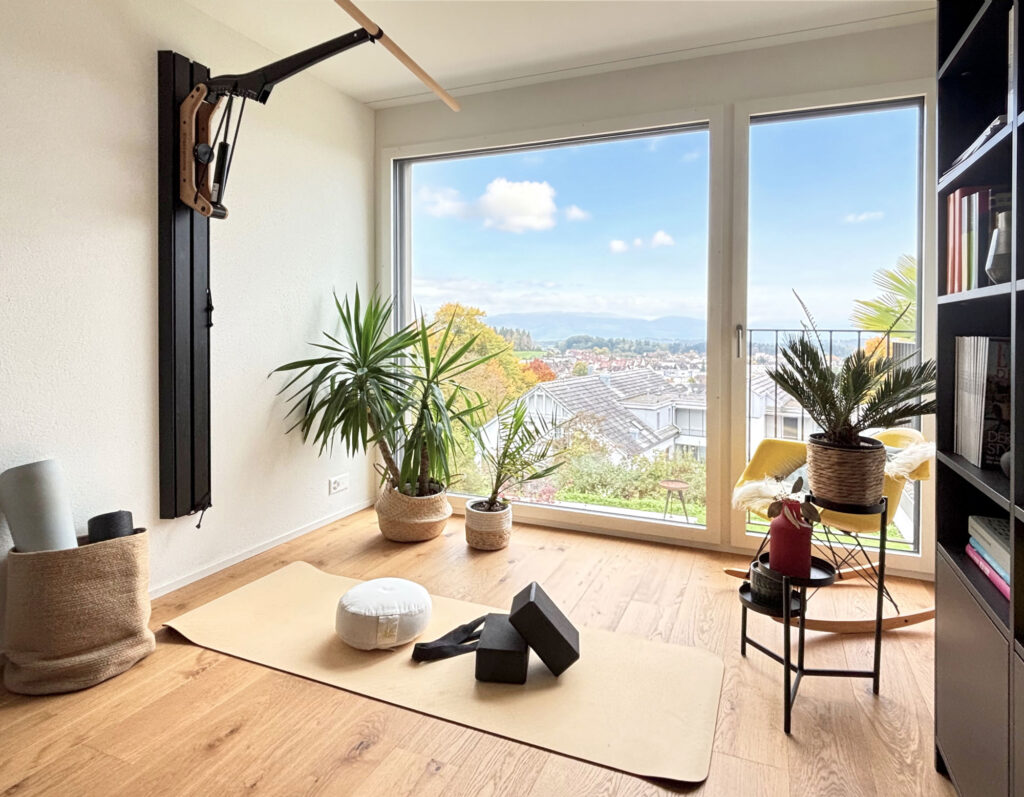
This is what my home workout corner looks like. The mats are neatly stowed away in seagrass baskets, ready to grab at any moment. The Eisenhorn I use for my workouts is wall-mounted, so it doesn't take up any floor space. This spot also doubles as my reading nook; there is usually a lightweight rocking chair here that I simply push aside when I want to work out. It takes just a couple of quick moves to get set up and start exercising right away and the beautiful view really enhances the experience.
2. Supporting Healthy Eating Through Design
Unhealthy patterns can't be erased, but they can be retrained. Remove unhealthy foods from their usual place and replace them with healthy alternatives. In stressful situations, your habitual reach will then lead you to the healthy option first. If you want to be absolutely sure, you should get rid of the unhealthy foods completely. If that's not possible, they should be stored in an unusual and hard-to-reach place. With the right organizational system, you can actively counteract bad habits.
I once saw a floor plan that incorporated a minibar into an oversized dressing room. I really don’t see the appeal of mixing yourself a drink amidst handbags and fur coats. To me, it suggests that consumerism serves as a powerful coping mechanism. A habit that should be critically examined rather than celebrated.
3. Creating a Space for True Relaxation
True relaxation isn't scrolling on your smartphone or binge-watching TV shows. Consciously create a place of retreat: place the sofa facing the window instead of the TV, place your smartphone in another room, and add atmospheric elements like candles, scents, or soft music. Your retreat should be so attractive that you look forward to it every day. Strictly follow rules like "no smartphone" in this zone to maintain its magic.
It is quite possible that your retreat doesn't evoke the feelings you desire right from the start. Remember, habits take practice. In our digital world, relaxation can feel uncomfortable at first because we are no longer used to being alone with our own thoughts. Over time, however, it becomes easier, and eventually, you can truly enjoy this space and have significantly more energy throughout the day.
Conclusion: Designing spaces, anchoring habits
New habits don’t grow in a vacuum. They need visible signals, small rewards, and an environment that supports themThoughtful interior design allows spaces to be created in a way that makes routines visible, attractive, and simple. This transforms homes into not only beautiful spaces but also tools for a healthier, more conscious life, because behavior and well-being are closely linked.
And if you'd like to learn more about how spaces influence our well-being, I have a detailed article about it here.
A well-thought-out spatial concept can address this issue directly and make changes significantly easier.
If you want to find out how your spaces can better support you, an individual analysis can be a useful next step.
FAQ
How does my environment influence my habits?
Our brains are constantly perceiving our surroundings. Visual perception is the strongest human sense; approximately 80% of all sensory input is visual. This means that the design of a space significantly influences our behavior, something we can use to our advantage. If I want to cultivate new habits, I can deliberately populate my environment with visual cues associated with those habits, making it easier to practice them in my daily life. Conversely, I can strip unwanted habits of their power by removing the visual cues that trigger them.
Can interior design foster healthy routines?
Yes. Thoughtful interior design can optimize spaces to foster healthy routines. To achieve this, I first analyze my clients' needs, habits, and goals, and then translate them into the spatial design. This process unfolds in several stages, ranging from zoning and material selection to the refinement of the finer details.
Which spaces are particularly suitable for practicing new habits?
In principle, any room can support new habits. The key is ensuring that the planned activities align with the room's function and atmosphere. A bedroom, for instance, is well-suited for quiet routines like yoga, meditation, or a reading nook. A home office can provide additional space for strength training or a musical instrument. It is important that the room makes the desired habit visible and makes carrying it out as easy as possible.