


Keeping things tidy: Why your home plays a crucial role
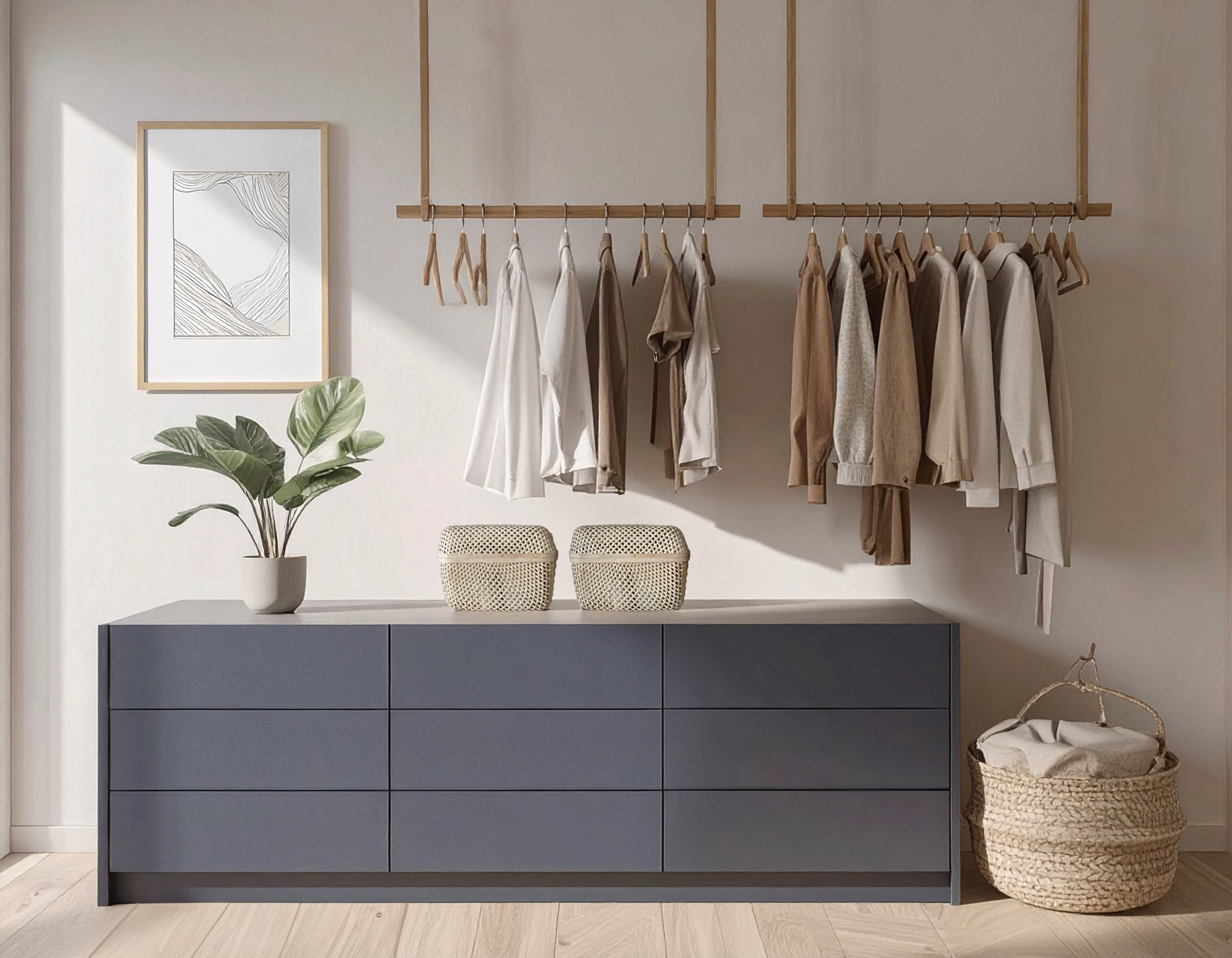
*Image inspired by my own wardrobe
Some people are naturally tidy. They clean up right away, never leave things lying around, and always seem to live in order. And then there are people like me: creative minds full of energy and ideas, but often struggling to keep things organized.
I love order. It gives me peace and clarity. Many people find it difficult to keep things tidy. Often, you start out motivated, tidy up, and a few days later everything looks the same as before.
My experience with clients as an interior designer in the Zurich area repeatedly shows that the problem is rarely a lack of discipline, but rather an environment that does not support order.
Because order is not a one-time state, but a system, and this system must be integrated into space.
In this article, you’ll learn why chaos happens, why tidying up without a system never lasts, and which methods (from Marie Kondo to practical hacks for stressed people) finally helped me bring lasting structure into my everyday life.
What chaos and order do to us
Chaos is not only straining for the eyes, but for our entire nervous system.
Das liegt dies daran, dass wir unsere Umgebung permanent scannen. Die Unordnung ist also ständig präsent und dies kann bei manchen Menschen richtige Stressgefühle und innere Unruhe auslösen.
Even concentration problems, sleep disorders and a depressed mood are possible consequences of disorganization (Source: Oberberg Kliniken).
The activity of tidying up, on the other hand, even releases serotonin, our happiness hormone (Source: Hirnliga). So it pays off to regularly clear away the clutter.
The myth that chaos is a sign of creativity also persists stubbornly. In fact, there is evidence that a bit of chaos can spark new ideas and foster a willingness to experiment. However, a small, cluttered corner is quite enough; if chaos and disarray reign everywhere, the negative consequences outweigh the benefits. So, for me, my desk will remain the place for creative chaos and, to some extent, my hobby room as well.
Why chaos happens
Clutter has many causes. Too little storage space, unclear processes, or poorly placed functions mean that things don't have a designated place, and that's exactly where the chaos begins.
Then there's this:
- Life with young children – chaos is part of the daily routine, because kids are just kids.
- Lack of time and stress – when life gets hectic, we switch to reaction mode, and tidying up takes a backseat.
- Procrastination – especially in the evenings, when energy runs low, cleaning up is the first thing we postpone.
Last but not least, order is closely linked to our daily habits. If we succeed in integrating order into these habits, things become much easier.
Why we struggle to stay organized
Anyone who wants to maintain order in the long term should not only question their behavior, but also their living situation.
A well-thought-out spatial structure can not only make order easier, but almost automatically create it.
Here’s the simple truth: Without a system, there is no order.
If you tidy up without structure, you’ll end up putting things away in random places. Next time, you won’t know where they belong and clutter builds up again.
Organization requires clear rules, designated spaces, and systems that make tidying easier. In her books, Marie Kondo teaches functional systems for all sorts of problem areas, which can serve as inspiration. I personally apply various aspects of her organizing systems, but also enjoy creating my own systems, tailored to my needs.
The Marie Kondo method: Simple but powerful
Japanese tidying expert Marie Kondo has inspired millions of people, including me. Her system works because it is simple and clear. I have interwoven her principles with my experience as an interior designer:
Organize by category
Essentially, you assign all items to categories and distribute them across the available storage space. A tree diagram is the most useful tool for this, providing orientation and facilitating a sensible categorization.
Everything has a fixed spot where it belongs
When everyday items don't have a designated place, we have to decide where to put them each time.
These constant micro-decisions drain our energy and, in the long run, lead to us simply leaving things lying around. If this becomes a persistent problem, it quickly creates a feeling of restlessness and being overwhelmed.
Good design reduces precisely these micro-decisions.
Visibility is key
You need to be able to see everything at a glance. Often we look inside cabinets and have trouble seeing what's on the top and bottom shelves. I recommend pull-out drawers for the bottom cabinets. They cost more, but they're definitely worth it. On the top shelves, the different categories are stored in labeled boxes, so their contents are immediately clear.
Less is more
Keep only what you truly need or love.
The first time feels like a massive challenge. When you finally start sorting and decluttering, you’ll find things you forgot you even owned. And that’s the point: if you didn’t even know it was there, it’s probably time to let it go.
The art of letting go
A key step toward organizing is sorting things out. Many people struggle with giving things away. I've learned that it's incredibly liberating.
When I moved from Germany to Switzerland, I took only half of my belongings. Later, when I moved to California for over three years, I brought even less. And you know what? I didn’t miss a single thing.
My tip: Anything you find while tidying up that you've long forgotten about can go. Give it away, donate it, or dispose of it. The fewer things you own, the easier it will be to create a functional system and maintain order.
You can also give unused items a “second chance.” For example, if you’re unsure about certain clothes, set a deadline: place them visibly in your closet and give them a few months. If you still haven’t worn them by then: it’s time to say goodbye.
My wardrobe: From chaos to structure
My closet used to be a constant battle. Today, it’s always organized thanks to the Marie Kondo folding system.
- lothes no longer lie stacked in piles but are folded upright in drawersso I can see everything instantly.
- I created clear categories: shorts, long pants, skirts, sportswear, T-shirts, tops, sweaters, loungewear.
- Underwear, socks & co. live in baskets, while blouses and dresses hang neatly on the rack.
The best part? Folding now takes very little time and seeing my tidy closet every day makes me proud and motivated to keep it that way.
Creative systems for stressed people: The “Dumping Space”
Especially with children or during stressful times, you sometimes need practical quick fixes. One idea I’ve tried: Dumping Space – a defined spot where things can temporarily land.
For example: a storage bench or trunk in the living room, disguised as seating or a side table. Everything that’s in the way can be tossed in there when time is short. The clutter is out of sight, and the stress level drops immediately.
Important: Set a weekly “reset time” to empty the Dumping Space and put things back in their proper places.
This is precisely where a intentional design approach comes into play, in which spaces are specifically tailored to everyday life.
Conclusion: Order needs systems
Being organized is not a personality trait. It’s a matter of structure. Whether it’s kids, stress, or procrastination: with the right systems, tidying becomes easier and more sustainable.
Order not only has a practical function, but also directly influences our well-being.
If you want to know more about how spaces affect our well-being, you can read this article.
Today, my closet is so organized I can hardly believe it myself. And it doesn’t take extra time or energy to keep it that way, because the system does the work for me.
Order isn't a goal you reach once and for all. It's the result of functioning structures in everyday life.
If your home doesn't support you in this, maintaining order will always be a struggle.
A well-designed space takes the burden of decision-making off your shoulders and creates the foundation for more peace, clarity, and ease in your daily life.
If you find that your home overwhelms you rather than supports you, it can be beneficial to rethink the space as a whole with lisannco
FAQ
Why do many people find it difficult to maintain order in the long run?
Many people respond to stressful situations by procrastinating. In other words, when things get hectic, we focus on what seems most urgent and important, putting the rest off until "later." The problem is that these small, unfinished tasks pile up, creating a mountain of work that requires significantly more time to tackle, leading us to postpone it yet again. At the heart of the issue is the perception that tidying up is time consuming. Yet this is actually a misconception; putting most things away takes only a few seconds, provided one has a good system in place.
To maintain order in the long run, therefore, you need a good system and a bit of practice to cement the routines of tidying up immediately.
How does the Marie Kondo method help with tidying up?
It helps us create a system that makes it easier—mentally speaking—to keep things organized. Consciously reducing possessions lowers the mental load, clear categorization establishes a system that is easy to maintain, and the arrangement of items within those categories ensures a clear visual overview.
How can interior architecture help maintain order in the long term?
A well-conceived interior architecture concept helps create an organizational system that is both functional and intuitive. Planning extends to the finest detail, particularly during the execution planning and implementation phases. Through collaboration with the client, a storage system is developed that meets individual needs and contributes to a tidy, low-stress home in the long term.