


Kitchen Renovation Planning – What Really Matters
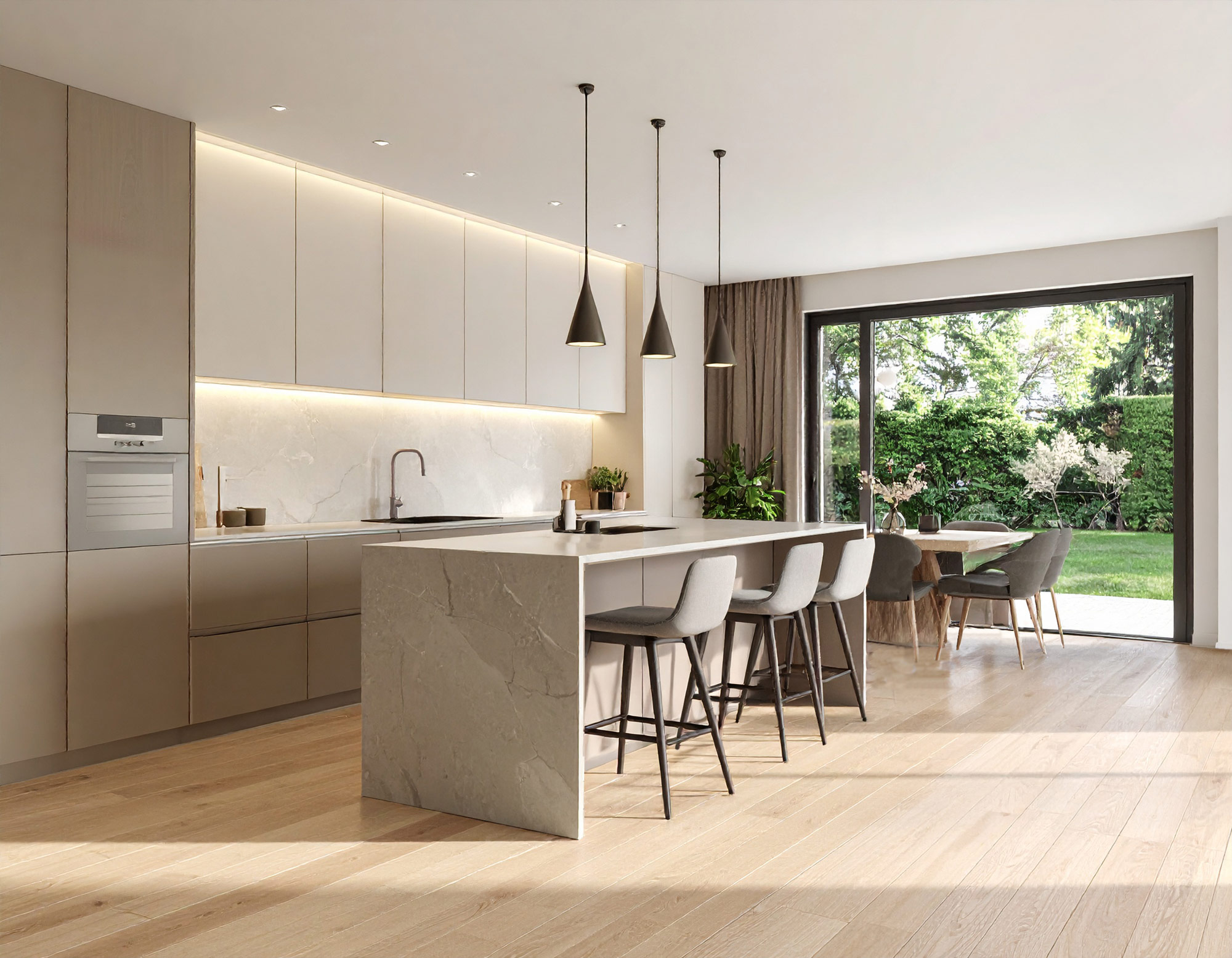
A kitchen renovation is one of the most technically demanding projects in a home. At the same time, the kitchen is a space that plays a central role in our everyday lives.
For a renovation to remain enjoyable in the long term, it takes more than attractive fronts. It requires thoughtful planning, well-designed workflows and decisions that will still make sense ten or fifteen years from now.
Optimising the Kitchen Layout – Less frustration, more ease
The first step in any kitchen renovation is the layout. Before materials or colours are discussed, it is essential to ask some fundamental questions:
- How do we move within the kitchen?
- Is cooking usually done alone, or by several people at the same time?
- What are the typical workflows in our kitchen?
A well-established planning principle is the so-called work triangle between refrigerator, sink and cooktop. Even so, it is worth closely examining your own habits and workflows and reviewing the layout based on your individual needs and on how the kitchen relates to adjacent spaces.
Equally important are the correct working heights. Worktops that are too low or too high can lead to back and neck pain. An individually adjusted height allows for comfortable, ergonomic work. If several people spend a similar amount of time cooking, a balanced average height can be a sensible solution.
Movement space in the kitchen is often incorrectly planned by non-professionals.
Between a kitchen run and an island, at least 110 cm should be planned, ideally 120 cm. This allows drawers and appliances to be opened while still enabling comfortable circulation.
Worktop space is also frequently sacrificed in favour of tall cabinets. However, sufficient work surface is essential. Not only for food preparation in general, but also as a landing area next to the refrigerator for loading and unloading, and next to the cooktop and sink. Cutting back here turns everyday kitchen use into an obstacle course.
Even in the bathroom, we often plan too narrowly and without considering our needs. I'd like to change that. Find out why here.
Storage in the Kitchen – Often planned too tightly
Insufficient storage is one of the most common planning mistakes in kitchens. Many people underestimate how many items they actually own. This is where the core issue lies. Without enough storage, there is no overview. In the end, there may be a brand-new kitchen, yet we still do not know what we have because items once again disappear into the back of cupboards. Cabinets filled to capacity lead to a loss of structure, clarity and time. The result is frustration and disorder.
The solution is either to plan more storage or to declutter beforehand.
My tip:
Make a complete inventory of your kitchen contents, categorise them and consciously assign them to drawers and cabinets.
Not a fan of this process? I genuinely enjoy this kind of planning and am happy to support you.
Drawers are more expensive than traditional cabinets, but functionally they are unmatched and well worth the investment in the long run:
- no more bending down or kneeling on the floor
- no more unpacking everything just to reach items at the back
- everything visible at a glance, organised and within easy reach
Incidentally, tidiness also has a significant impact on our stress levels. You can learn how to maintain order permanently in this article..
Kitchen Materials – Where aesthetics meet maintenance
In the kitchen, materials need to do more than look good. They must withstand acids and fats, sharp tools and hot pots, and regular cleaning after every use.
KITCHENFRONTS
Laminate fronts with anti-fingerprint surfaces are slightly more expensive, but they significantly reduce daily maintenance. They are easy to clean and resistant to visible marks. Egger and Pfleiderer offer very good solutions in this area, and Fenix is also a strong alternative. Laminate fronts are by far the most durable and robust option.
Wood veneered fronts do not have to be overly delicate. While they are more prone to scratches, they conceal marks very well when they have a visible grain. The key requirement is proper surface sealing to protect against water, grease and acids.
COUNTERTOPS
Natural stone is often romanticised for its perceived quality and natural appeal. What many underestimate:
- high maintenance requirements, often no soap-based cleaners allowed
- regular impregnation necessary
- susceptibility to staining, especially marble
As alternatives to natural stone, I often choose ceramic or quartz composites. Quartz composites such as Silestone are very easy to maintain and available in a wide range of colours and finishes. Their appearance is consistent throughout the material, including cut edges, which makes the edges visually appealing as well. In terms of robustness, quartz composite performs less well. Edges can chip more easily, repairs are difficult, and hot pots can cause permanent discolouration.
Ceramic is my personal favourite. It is heat-resistant and robust like natural stone, but overall much easier to maintain. Visually, it can closely resemble natural stone. However, the design is usually printed only on the surface, meaning that cut edges do not have the same appearance. This must be considered carefully during planning.
My tip:
Regardless of whether ceramic, quartz composite or natural stone is chosen, hot pots can leave marks on any surface and manufacturers generally do not guarantee heat resistance. Highly polished, high-gloss surfaces are also more prone to scratches. In addition, they often reflect light, which can cause unpleasant light reflections on the ceiling.
TAPS AND FAUCETS
Taps also deserve a closer look. While they are available in countless colours today, the type of surface finish is crucial. Coloured, powder-coated taps tend to be less durable, as the coating can wear away at the edges. Black taps are also particularly prone to limescale marks. Chrome is affordable, but every fingerprint is visible and it reacts sensitively to acids. Stainless steel, especially brushed, is timeless, robust and high-quality in appearance, making it my personal favourite.
COLOUR
Many people shy away from choosing a coloured kitchen and opt for white instead. However, neither all-white nor all-black kitchens are ideal. White kitchens often appear flat and lack impact, while black kitchens can be striking but may overwhelm a space if the context is not right.
Kitchens are active, lived-in spaces. Natural colour tones that clearly contrast with the walls create warmth and everyday practicality. Accents can always be added later.
Lighting Design in the Kitchen – Less is not always more
Good lighting is not a nice-to-have, but a fundamental requirement for a functional kitchen. Effective kitchen lighting always consists of multiple light sources:
- general lighting for the room, ideally via ceiling spots
- targeted task lighting where food is prepared, cooked and cut
- optional pendant lighting to create atmosphere, especially in open-plan kitchens
Special care must be taken with the placement of ceiling spots. They should illuminate circulation paths and work surfaces equally. If they are positioned incorrectly, for example only between the island and the kitchen run, you end up casting shadows on the work surface while cooking. For this reason, LED under-cabinet lighting is essential beneath wall cabinets. It provides even, shadow-free illumination of the worktop. For freestanding kitchen islands, light sources should also be planned above the island.
Kitchens can handle stronger light levels. In a space where sharp knives and hot pots are used, insufficient lighting is unprofessional.
In generous open-plan kitchens with islands, pendant lights can be used as an atmospheric element.
For all light sources, it is important to choose a consistent Kelvin temperature. Mixed light colours make a kitchen feel restless and inexpensive.
Light not only affects what we see, but also has a strong impact on our energy levels. You can find out more here.
Appliances, Power and Technology – Look closely
The range of appliances is vast and the technology often difficult to understand. As a result, decisions are frequently made impulsively.
Downdraft Ventilation in the Cooktop, for Example Bora
Visually, these systems are elegant and they do work. However, they also have limitations. Recirculation means that the filtered air is returned to the room. With Bora systems, extraction happens directly at the cooktop and the air is released at plinth level. If planning is not handled carefully, the cleaned air can be blown directly onto your feet while cooking, which is extremely uncomfortable. In addition, even a Bora system cannot override the laws of physics. When searing at high heat, for example when cooking a steak, a large amount of smoke is produced that cannot be fully extracted and will spread through the room. This raises important questions. Can you ventilate quickly by opening windows? Can adjacent rooms be adequately separated, for example with doors? Anyone who wants to minimise odours and smoke will ultimately need a powerful ducted extraction hood.
Steam Ovens
Steam ovens only make real sense with a fixed water connection. Water tanks need to be refilled every time and emptied again after use to avoid hygiene issues. This results in significantly more maintenance. The same applies to refrigerators with ice makers, even when connected to a fixed water supply. High cleaning effort and hygiene concerns often lead to these features no longer being used after some time.
Power and Technology
A kitchen is typically planned for 15 to 20 years.
Technology becomes outdated much faster.
This makes future-oriented planning essential:
- better to plan too many power outlets than too few
- place outlets where appliances are actually used, such as on work surfaces, near the cooktop, possibly even inside drawers or cabinets, and in the bar area of a kitchen island
- those who plan ahead integrate empty conduits to allow for future upgrades and new technologies
Conclusion: A kitchen renovation is complex and requires expertise
A kitchen renovation demands technical knowledge, experience and careful planning.
It is not about what looks good today, but about what will function reliably in the long term and create real value.
If you would like to learn more about what interior architecture can achieve and what mistakes you can avoid with a good interior architect, then you will find this information here.
I have planned many kitchens and know exactly what matters. lisannco is happy to support you with your kitchen renovation, from the first sketch through to completion.