

Lighting design - light for focus, rest and sleep

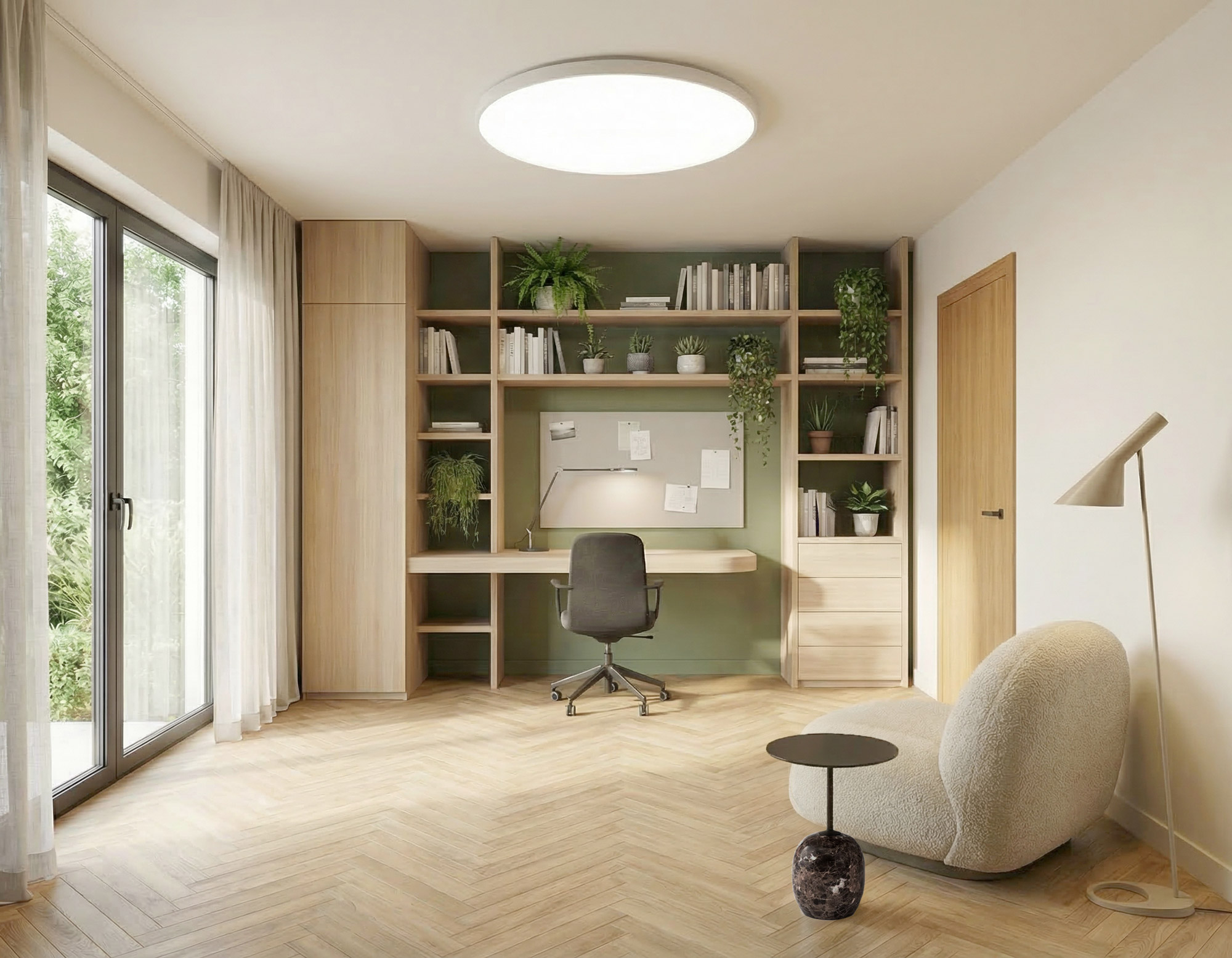
For a long time, as an interior designer in Switzerland, it was important to me that all light sources in my renovation projects had a uniform color temperature. Visually, it was simply the most pleasing. But aesthetics alone aren't enough. Light influences far more than just the atmosphere of a room. It directly affects our bodies. And our health and well-being in everyday life are more important than a visually more appealing light color, which is why a well-thought-out and intelligent lighting concept is indispensable.
This article will show you how to use light in your home to suit your lifestyle and rhythm. And at the end, we'll look at where the future of lighting might lead.
Light, biorhythm and health
Our internal clock, the circadian rhythm, is primarily regulated by light and darkness. Special light-sensitive cells in the retina (called ganglion cells) signal to the brain whether it is day or night. This, in turn, controls our sleep, mood, and performance.
- In the mornings and during the day, very bright, short-wavelength light causes an increase in activating hormones like cortisol and mood-enhancing neurotransmitters like serotonin. We feel awake, fit, and motivated.
- As darkness falls, i.e., as light decreases, melatonin production increases, our "sleep hormone" which prepares the body for regeneration and recovery, and we become increasingly tired.
So much for the basics. For everyday life at home and at work, this basically means: the better your indoor lighting mimics the natural daylight cycle outdoors, the more you support your circadian rhythm. And especially in winter, we "help" our bodies stay awake longer by using artificial light.
Lux, Kelvin, Lumen: Fundamentals of lighting design
To better understand light, we need to take a closer look at a few more terms:
- Lumen (lm): Indicates how much light a lamp emits overall – the more lumens, the "brighter" the light source appears.
- Lux (lx)Describes how much light actually reaches a surface, for example, a desk. In an office, around 500 lux is often recommended for concentrated work. (DIN EN 12464-1)
- Kelvin (K): Indicates the light color:
- Approx. 2,700–3,000 K: warm white, cozy, rather reddish-yellowish
- approx. 3,300–4,000 K: neutral white
- Approx. 5,000–6,500 K: daylight white, cool, with a higher blue component.
- Color rendering (CRI/RA value): Shows how true to life colors appear under a light source – the closer to 100, the better.
These terms are usually unfamiliar to the average person. Light bulbs are often selected based on wattage and perhaps also on whether they are described as warm white or neutral white. However, lumens, lux, Kelvin, and the CRI or Ra value actually provide the crucial information about the quality of the light and whether it is suitable for a particular application.
While lumens, Kelvin, and the CRI value are usually specified directly on the light source, illuminance in lux usually needs to be calculated. A simple approximation is:
Lux = Lumen / m2 area
This means that if I use a light source with 1000 lumens in a room of 10 m², the resulting illuminance is approximately 100 lux per square meter. However, for more precise calculations, other factors play a role, such as the beam angle of the light, the room geometry, and the distance to the illuminated surface. (simple calculator by led.de)
A simple rule of thumb helps in everyday life: the higher the amount of light in lumens and the cooler or whiter the color temperature in Kelvin, the more activating the light is for our circadian rhythm. Conversely, the lower the brightness and the warmer the light, the more it promotes relaxation and calmness.
While this simplified rule does not replace precise lighting design, it provides good guidance for the conscious use of light in everyday life.
Below we will look at two explicit examples.
Lighting in the home office: Light for focus and concentration
A well-planned workplace feels light, clear, and focused, and that's exactly what light can do.
1. Use daylight
The best light comes from nature. A workspace without daylight is not a good idea. Position your desk perpendicular to the window, if possible, to get side sunlight and avoid glare and reflections on the screen.
2. general lighting
Ceiling light with a neutral to daylight white light color (approx. 3,500–5,000 K) and sufficient brightness (pay attention to lumens and lux) so that the room is evenly illuminated overall.
Personally, I prefer large, round panel lights, ideally with indirect lighting directed towards the ceiling. Microprismatic or opal diffusers are perfect for illuminating the room evenly and softly without harsh shadows or glare. These lights are often dimmable and, unlike standard bulbs, offer several thousand lumens, which is perfect for a workspace focused on concentration and motivation.
3. Workplace lamp
An adjustable desk lamp with glare-free, directional light; preferably dimmable and with adjustable color temperature, so you can change it depending on the time of day and the task at hand. This is an absolute must-have.
This creates a workspace that is easy on the eyes, promotes concentration, and reflects your natural rhythm. You can find more tips for an efficient home office setup in this article: Home Office
Good light for relaxation: Lighting design for living rooms and bedrooms
In living and sleeping areas, light should be soft, zoned and atmospheric, especially from late afternoon onwards, to set the stage for restful sleep.
living room
- A rather subtle ambient lighting for the day, e.g. built-in ceiling spotlights (3000 K).
- Several small light sources such as floor lamps, table lamps or indirect LED lighting for individual zones and scenarios (reading corner, sofa,…) and corresponding color temperatures (approx. 2700-3000K)
- Choose dimmable light sources if possible, in order to gradually reduce the brightness in the evening.
Bedroom
- Avoid very bright, cool white ceiling spotlights. Soft, warm white lights are better in the bed area.
- Bedside lamps with warm, indirect light for reading without harsh contrasts.
- In the area of wardrobes, directional spotlights with more lumens and a color temperature of 3000K can be used, but they should be able to be switched on and off separately from the main light in the room.
- Ideally, reduce light intensity one to two hours before bedtime; this supports melatonin production and makes it easier to fall asleep. Therefore, avoid bright smartphone screens as much as possible.
Consciously used, warm evening light signals to your body: slow down, wind down, regenerate.
If you need more tips on kitchen lighting design, you'll find them in this article: kitchen planning
Tips & tricks for everyday lighting design
Our living spaces rarely serve just one specific purpose. They are often as multifaceted as we are ourselves. To ensure that the light works for all these purposes, here are a few tips and tricks for intelligent lighting design.
Human Centric Lighting: HCL is a design approach that uses adjustable LED technology to mimic the natural daylight cycle. So-called tunable white light sources are now available from numerous manufacturers and are sometimes very affordable. They allow users to switch from cooler daytime work light to warm evening light, often directly via an app.
Smart controls: Timers and automations for different scenarios can automatically provide brighter, cooler light in the morning and warmer, dimmed light in the evening. This can be achieved either with tunable white light bulbs or by controlling different lights with varying color temperatures. Even this can be accomplished today with just a few tools. Of course, you have to put in some initial effort to set everything up and then fine-tune it, but the added comfort in your own home is well worth the effort.
Multiple light sources instead of a single one: No room should have only a single light source; even in nature, light comes from everywhere. A combination of ambient light, task lighting, and accent lighting creates depth, coziness, and functional brightness, depending on the need.
Choose technology realistically: Ensure sufficient lumens, appropriate Kelvin values, and a good color rendering index. It's better to have slightly more brightness plus a dimmer than to have rooms that are permanently too dark.
The combination of the first two aspects, HCL and smart controls, can also be aesthetically convincing, as we can adjust scenarios and rooms in a targeted and coordinated manner.
Planning all of this on your own can be overwhelming. How an Interior Designer can help you plan your home holistically can be read in this article.
The light of the future – melanopic lux
Our retinal ganglion cells are particularly sensitive in the range of approximately 480 nm, i.e., in the blue spectrum. Light in this wavelength range therefore has a particularly strong influence on our biological clock. For this reason, we tend to use cooler, blue-rich light in the workplace, while warmer light is preferred in the evening, as it interferes less with this mechanism and promotes relaxation.
How exactly light affects our bodies can now be measured with increasing precision, using so-called melanopic lux (more precisely: melanopic equivalent daylight illuminance, mEDI). This quantity does not describe brightness in the classical sense, but rather the biological effect of light on melanopsin, a protein in ganglion cells that plays a central role in our circadian rhythm.
This provides, for the first time, a measurement parameter that captures not only the visual but also the physiological effects of light. Currently, it is primarily used in larger architectural and lighting projects, for example, within the framework of certifications such as the WELL Building Standard, because the calculation and planning are still relatively complex.
However, it is foreseeable that this will change in the coming years. With increasing standardization and technological development, melanopic parameters could also find their way into consumer products in the future.
This would be a huge step forward for residential design. Instead of color temperatures, which only provide rough indications of the effect of light, a truly physiologically relevant measurement would be available. This would allow spaces to be designed not only to be visually harmonious, but also specifically tailored to human well-being through lighting design that considers both aesthetic and biological needs.
Conclusion: Light is more than "bright enough".
Light not only enables us to see, it also regulates our biorhythm and influences our hormones.
Whether you're working from home, relaxing on the sofa, or in the bedroom, light determines how awake, focused, or relaxed we feel. With the right lighting and the right light color, you can make your everyday life not only more pleasant but also healthier.
You can find a detailed article on how spaces influence our well-being here.
I'd be happy to help you develop a customized lighting concept. I can also support you in other areas related to the topic Residential Design
FAQ
How many lux should a workspace in a home office have?
Your work surface should generally have 500 lux. General ceiling lighting and a desk lamp are usually sufficient, but adequate daylight is also essential. The desk lamp should be adjustable to avoid glare, and especially during the day, neutral or cooler light (>4000K) is beneficial for concentration.
Which light color is best for focused work?
During the day, daylight-white light colors (around 5000 Kelvin) are best for concentration and energy. This light has an activating effect and helps us stay awake and motivated.
What light color is appropriate in the evening?
In the evening, you should reduce the amount of blue light to support your body's natural melatonin production. Warm light colors up to a maximum of 3000 Kelvin are recommended. Also, be sure to reduce the brightness of your TV and smartphone screens in the evening, or avoid using these devices for one to two hours before bedtime.
Is a single ceiling light sufficient?
In most cases, probably not, unless it's a storage room. A single light source produces flat and unpleasant light and often leads to harsh shadows. A combination of ceiling lights and floor and table lamps, or indirect LED lighting, is better.
Can a lighting concept be improved retroactively in existing apartments?
Yes, even retrofitting and without major renovations can significantly improve lighting. By adjusting the light sources and installing additional fixtures, the atmosphere of a room can be fundamentally transformed. A professional partner can help you make your rooms more pleasant and functional.
What is needed for good lighting design?
To develop a good lighting design, a holistic understanding of the use of the rooms and the needs of the residents is needed, as well as good knowledge of the properties of light.
As a layperson, you can learn this yourself if you have the time and the will. Of course, it's easier, faster, and more professional with a specialist. lisannco can create a tailor-made lighting concept to suit your needs.
When is professional lighting design worthwhile?
Professional lighting design is always worthwhile, as light has a strong influence on our health and well-being.
Ideally, lighting design is incorporated into renovations, remodeling, or new builds early in the planning process. However, even in existing spaces without major renovations, professional lighting design can significantly improve the perception of the rooms. lisannco specializes in renovations and is happy to assist you.
How much does professional lighting design cost?
Since the scope of work varies considerably, it's difficult to give a general price. lisannco charges the same hourly rate for all interior design services and always discloses these costs transparently to the client. I'd be happy to provide you with a free, no-obligation quote.