

Office Design – Why Happy Employees Are the Key to Sustainable Success
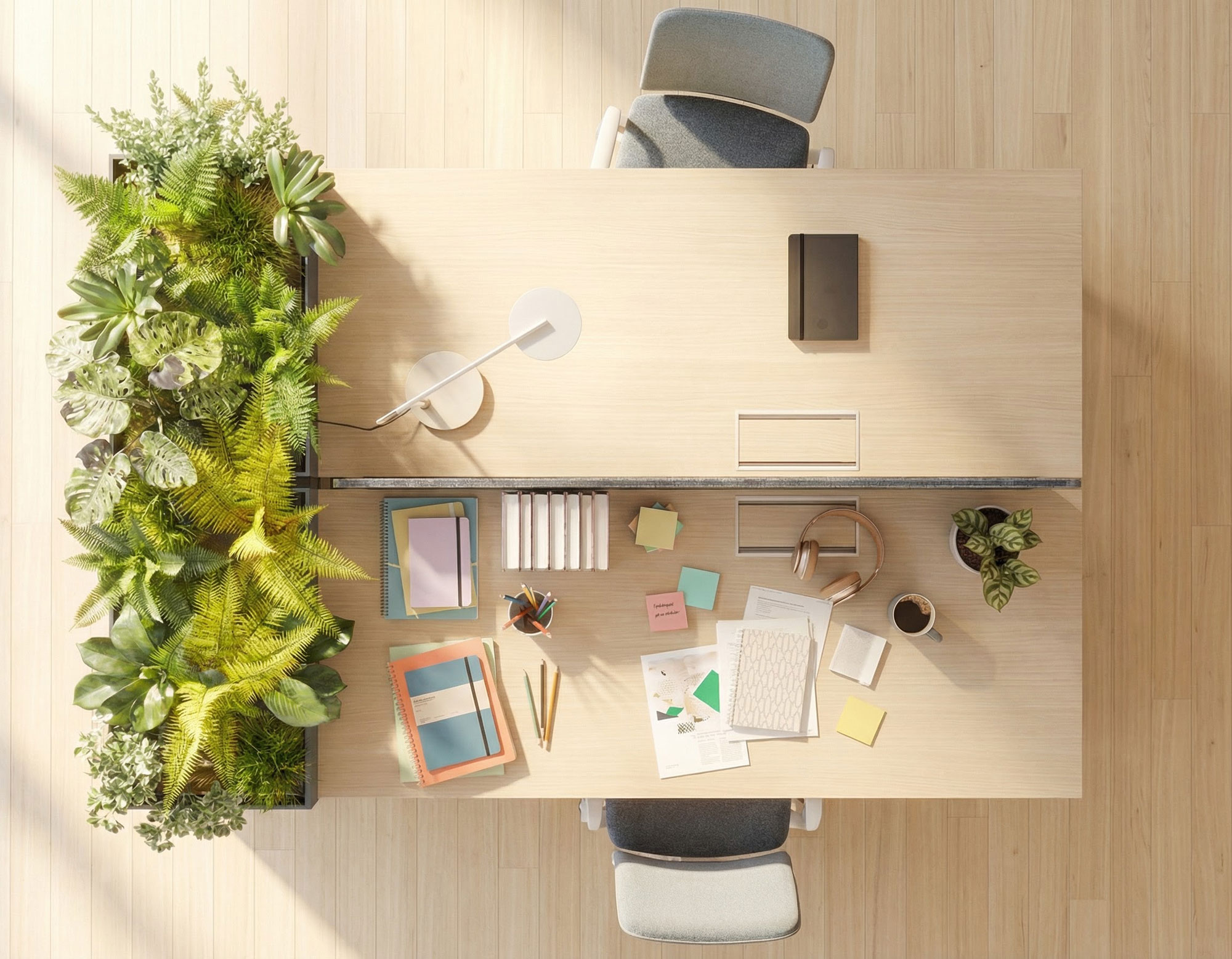
Happy employees perform better
Data from more than 7,500 companies show that those with happier employees perform significantly better (Source).
This clearly demonstrates that well-being at work is not a "nice-to-have" but a strategic necessity for companies.
So how can genuine well-being be created? By designing spaces that understand people, not just as workers, but as individuals with unique needs.
You can find a detailed article on how spaces influence our well-being here.
Why the average office doesn’t work
Every person is unique. Yet many companies design their offices based on a supposed “average employee.”
The problem: the average employee does not exist.
Spaces that “somewhat fit everyone” ultimately fit no one. The consequence: frustration, reduced focus, and lower motivation over time. Good office design for companies therefore embraces diversity in workspace types, work zones, and communication styles.
Incidentally, open-plan offices have demonstrably negative effects on health and well-being. Why this is can be read in detail in my article "Open-plan office – the balancing act between collaboration and concentration".
Introvert or extrovert? Two work worlds, one goal
A frequently overlooked aspect is how personality types experience space differently.
Employers often try to treat everyone the same, assuming that this creates fairness, but in reality, it achieves the opposite.
Susan Cain , in her book Quiet vividly describes the differences between extroverts and introverts. She references studies showing that introverted people react much more strongly to all kinds of stimuli, making them more easily exhausted by sensory input, light, and noise.
Extroverts, on the other hand, thrive in lively, stimulating environments.
Treating both the same isn’t fair, it’s unfair and deprives at least one side of the opportunity to perform at their best.
At this point you might be interested in another article if mine: "Retreat Spaces – The Quiet Powerhouses of Modern Workplaces".
From the standard office to a diverse workspace
A good workplace concept offers choice depending on work mode and personality type.
Quiet zones and spaces for collaboration, areas for small team sessions in a relaxed atmosphere, as well as open areas for town halls and community moments. A comprehensive guideline to designing a modern office can be found here.
Also you need to know who your employees are and that only happens through open dialogue.
Involving employees: The key to successful office design
Companies that want sustainable Office design must actively involve their employees in the design process. This can be achieved in several ways:
- Anonymous employee surveys – to gather quantitative data about needs and sentiment
- Interviews – conducted by external, objective experts to gain qualitative insights
- Workshops – in teams, to bring ideas to life and create a shared vision
lisannco Interior Design can guide you on this journey and help make your employees’ needs visible.
Prototyping & evolution instead of a final state
No office should ever be considered “finished.” Companies evolve, grow, pivot, and transform and their workspaces must evolve with them.
Through prototype spaces, regular feedback, and iterative adjustments, organizations can progressively find the right balance.
Conclusion: Sustainable office design is a living process
Even after an office design is completed and the team has moved into the new space, the process isn’t over, it remains alive.
lisannco Interior Design supports companies from the first analysis through pilot projects to full implementation and beyond. The goal is to establish tools and processes that lead to happier, more productive employees in the long term.
Because good design doesn’t start with plans.
It starts with people.