

The Future of Work: A guide to modern Office Design and Corporate Culture
Article content
The future is uncertain
By 2025 at the lates, when artificial intelligence had increasingly evolved from a supportive tool into an autonomous actor, it had become clear that nothing is clear anylonger. The speed at which technologies, ways of working, and entire job profiles are changing is daunting. It no longer seems possible to predict what the world of work will look like in five years.
That is precisely why a workplace that is to function successfully in the future must be one thing above all else: flexible.
Fields of work will change. Some tasks will disappear, while new ones will emerge. Certain activities will be automated, while others will suddenly take on new significance. Companies therefore face a crucial question: How can they maintain a strong corporate culture and a clear identity despite this constant change?
This article addresses precisely that question.
Modern corporate culture instead of rigid hierarchies
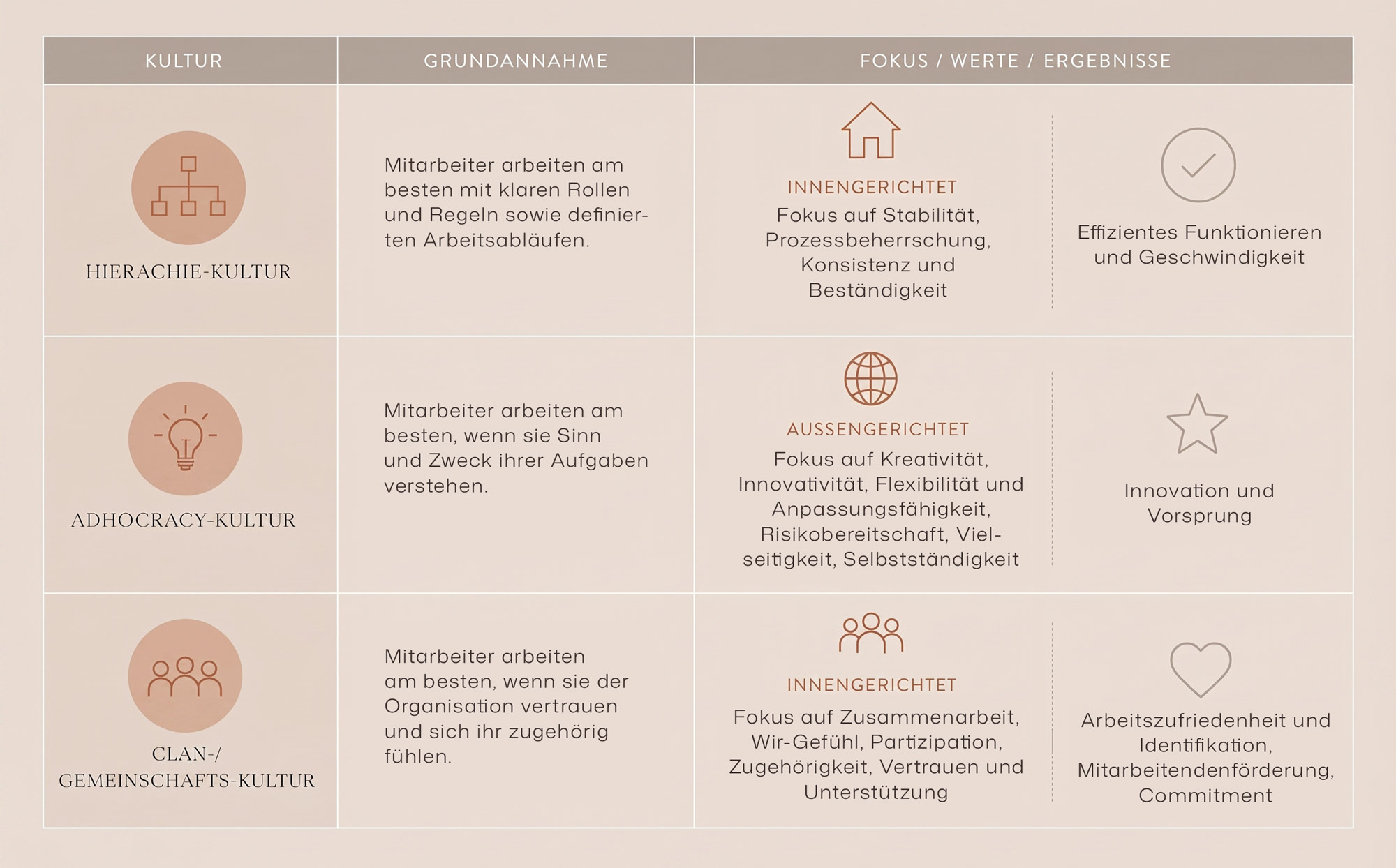
Switzerland continues to be strongly shaped by so-called hierarchical cultures (Hartnell et al., 2011). Employees assume clearly defined roles, processes are regulated, and responsibilities are clearly assigned. This cultural model is designed for efficiency, stability, and speed and it is precisely these qualities that have made our working world successful for many decades.
Even before the COVID-19 pandemic, and certainly during it, other organizational forms began to gain increasing prominence. Thanks in no small part to the example set by many Silicon Valley companies, the so-called “adhocracy” culture came more into focus. This is a culture in which employees perform particularly well when they understand the meaning and purpose of their tasks, can act independently, and innovation is actively encouraged.
At the same time, the “clan” or community culture also gained prominence. Here, trust, cohesion, and a sense of belonging take center stage. The goal is not only economic success but also high job satisfaction and a strong commitment to the company.
The reason for this shift is understandable. At some point, it became clear that the ever- increasing pace and constant pressure to be efficient were pushing the human brain to its limits. Burnout rates rose dramatically. At the same time, Millennials and Generation Z, in particular, began to have different expectations of their employers. Issues such as meaningfulness, personal development, and quality of life came more into the foreground.
At least in theory.
In practice, however, even modern organizational structures often exhibit the same trends as before: greater speed, greater efficiency, and ever-increasing competitive pressure. Artificial intelligence acts as an additional accelerator in this process. Even before a genuine adhocracy or clan culture could take root in many places, the world of work is already changing once again. Employees are confronted with new technologies, and at the same time, new uncertainties are emerging. The fear of falling behind or eventually being replaced now follows many people right into their evenings.
Despite all these changes, however, there is one constant that will still hold true in five or ten years: people want to make a meaningful contribution. They want to feel needed.
Employees, real people with their experiences, creativity, and personalities remain a company’s most valuable asset. Even if a future superintelligence were one day to become more intelligent and efficient than any of us, humans, with their complexity, empathy, and ability to intuitively grasp complex relationships, will remain the more exciting and ultimately more valuable asset.
Technology can accelerate processes. Culture, however, is created exclusively by people. That is why the clan community, with a touch of adhocracy, will be the strongest of all corporate forms in the future.
*Based on Hartnell, Ou, and Kinicki (Hartnell et al. 2011)
Why people should be at the heart of the working world
So what does the office of the future need to retain this most valuable asset in the long term?
The answer is: an uncompromising focus on people.
The crucial questions, therefore, are not: How do I make the company more efficient? Or: How do I ensure that my company will still be competitive in 5 years?
The better questions require a shift in perspective from the company to the employees.
How can I support my employees so they can become more efficient?
The answer does not lie in a single measure. It arises from the sum of many small elements that reinforce one another. It is precisely in this accumulation that the key to long-term corporate success lies.
These elements can be divided into three areas:
- Work Environment
- Flexibility
- Tools
You might also be interested in my post "Why Happy Employees Are the Key to Sustainable Success" in this context.
Since this is an interior design blog, I’m dedicating most of this article to the environment. This is where I can most effectively draw on my experience and expertise. However, the topics of flexibility and tools also play a central role and deserve attention. After all, it’s only when all three areas work together that a work environment emerges that empowers people and ensures long-term success for companies.
The work environment as a success factor
The environment influences people mostly unconsciously, but with lasting effects. It helps determine whether we feel safe or tense, whether we can work with focus or are constantly distracted, and whether we remain mentally alert or become exhausted after just a few hours. You can find a full article on how our environment influences our well-being here.
Many companies invest a lot of money in technology and processes, but underestimate the influence of the physical environment. Yet employees spend a large part of their day right there. The work environment should therefore not only look nice but also actively support people in working in a healthy, focused, and motivated way.
The foundations of a healthy work environment
For me, the fundamentals of a good work environment include three key areas: acoustics, lighting, and ergonomics.
These three factors form the foundation of any functional work environment and apply across all areas of the workplace. If even one of these basic conditions is lacking, even the most beautiful and modern office cannot fulfill its potential. A stylish interior is no substitute for good acoustics. High-quality furniture cannot compensate for poor lighting. And even the most expensive design concept loses its value if employees become physically or mentally fatigued.
That’s why it’s worth investing in these fundamentals first.
Acoustics
Good acoustics do not mean silence. Good acoustics mean less reverberation.
Our built environment consists largely of sound-reflective materials. Concrete, glass, and masonry reflect sound extremely well. As a result, sound waves bounce around the room like ping-pong balls and overwhelm our brains with stimuli. We feel exhausted or irritable more quickly, or simply have a harder time concentrating.
As soon as reverberation is significantly reduced, the room’s atmosphere changes immediately. A room feels more pleasant and less stressful, regardless of whether I can still hear my neighbor’s conversation or not.
To effectively reduce reverberation, a simple rule of thumb applies: At least one of every two opposing hard surfaces should be acoustically treated. This could be, for example, a wall or the ceiling in combination with a hard floor.
For the frequencies of human speech, porous absorbers are usually sufficient. Felt, acoustic foam, or similar materials, mounted directly on a wall or ceiling, are already highly effective.
Absorption is even better (especially for lower frequencies) if a small air gap remains between the absorber and the solid wall or ceiling. This allows the air to vibrate, effectively absorbing even longer sound waves. Whenever possible, I therefore recommend allowing for a certain distance from the ceiling, especially with ceiling panels.
Lighting
Light is far more than just a design element. It is part of our biology.
Light regulates hormonal processes and directly influences whether we feel awake, focused, or tired. Nevertheless, lighting designs are often planned based solely on visual criteria. Using the same color temperature throughout a space appears more visually harmonious than mixing different lighting moods. For humans, however, this is not the best solution.
Ideally, artificial light should mimic the natural progression of daylight. Modern lighting systems can automatically adjust their color temperature and brightness throughout the day, thereby supporting our natural circadian rhythm.
Such systems are very costly and should be factored into budget planning early on. In my opinion, however, lighting is one of those investments that pays off in the long run.
If a dynamic lighting system isn’t possible, I like to follow a simple rule of thumb:
Every workstation should have an individually adjustable desk lamp. Brightness and color temperature should be adjustable to suit personal needs.
The general room lighting around workstations should be neutral and as evenly distributed as possible. Direct and indirect light complement each other perfectly in this context. Opal or, even better, microprismatic covers reduce glare and create a more pleasant lighting environment.
Of course, other areas may have a different lighting atmosphere. A quiet retreat benefits from warm, dimmed light. A cafeteria or lounge area usually feels much fresher and more inviting with neutral or slightly warm light around 3000 Kelvin.
You can find a more in-depth look at the topic of lighting here.
Ergonomics
When it comes to ergonomics, I hold a slightly different view than many traditional ergonomics consultants.
I don’t believe in the one “perfect” office chair or the one “perfect” angle between the screen and the eyes. The human body isn’t designed to remain in a single posture for hours on end, even if that posture is theoretically optimal.
The magic word is “dynamism.”
It’s not sitting itself that’s the problem, but staying in the same position for too long.
Instead of providing every employee with the most expensive ergonomic office chair, it’s often more worthwhile to offer a variety of work options. Standing desks, lounges, quiet zones, or small work nooks encourage natural changes in posture while also bringing variety to the workday.
Regular breaks are just as important. Getting up about every 60 to 90 minutes to rest your eyes and take a few steps not only keeps your joints mobile and your neck supple but also improves concentration and performance.
There are now even apps like Freedom or Cold Turkey Blockerthat temporarily lock the screen to prompt employees to take breaks.
As a CEO, you shouldn’t view breaks as efficiency killers. On the contrary: they promote health, mental resilience, and, in the long run, productivity as well.
Office Zoning: Designing Spaces Based on Tasks
A well-functioning work environment requires thoughtful zoning. It plays a decisive role in determining how efficient the workday actually is. This isn’t just about walking distances, but also about interdependencies, work processes, and the different requirements of individual teams.
Which areas benefit from natural light? Which departments work closely together and should therefore be located near each other? Where are there interesting points of intersection? Which rooms are used by all employees and should be placed as centrally as possible?
It’s often the case that senior management gets the largest, brightest, and most attractive area of the office. This decision is understandable, as they bear the greatest responsibility and have the most decision-making power. At the same time, however, it also means that the majority of employees work under less-than-ideal conditions and have to make compromises every day.
The crucial question, therefore, is: Is this really the best decision for the company’s long-term success?
I am convinced that zoning should not be based on hierarchies, but rather on people’s needs and the demands of their work. The greatest focus should be placed where the most value is created.
That’s why it’s worth developing different options and thoroughly considering their implications. Even small changes can have a major impact on communication, collaboration, and productivity.
Equally important is the deliberate separation of areas that have completely different requirements. For example, an open collaboration space should not be directly adjacent to a quiet area. In larger companies, this is why we’re increasingly seeing so-called “silent floors”, entire floors dedicated exclusively to focused work and rest. Even if this solution isn’t feasible everywhere, it clearly demonstrates just how important thoughtful zoning has become.
Open-plan office
Space efficiency will remain a key issue in the future. That’s why the open-plan office will continue to be part of our working world for a long time to come.
The open-plan office has undeniable advantages. Hardly any other office layout offers comparable flexibility. Workstations can be reorganized at any time, teams can grow or shrink, and future changes can be implemented much more easily than in a compartmentalized space. Especially in light of an uncertain future, this adaptability is a major advantage.
However, the disadvantages are just as well known. Poor acoustics, a lack of privacy, and high sensory overload have been proven to negatively impact concentration, well-being, and work performance. You can read more about this here .
The goal, therefore, is not to eliminate open-plan offices, but to specifically address their weaknesses.
One effective solution is to install acoustic screens directly at workstations. They reduce noise, limit sightlines, and simultaneously create a greater sense of privacy. In addition, privacy screens for monitors can be used.
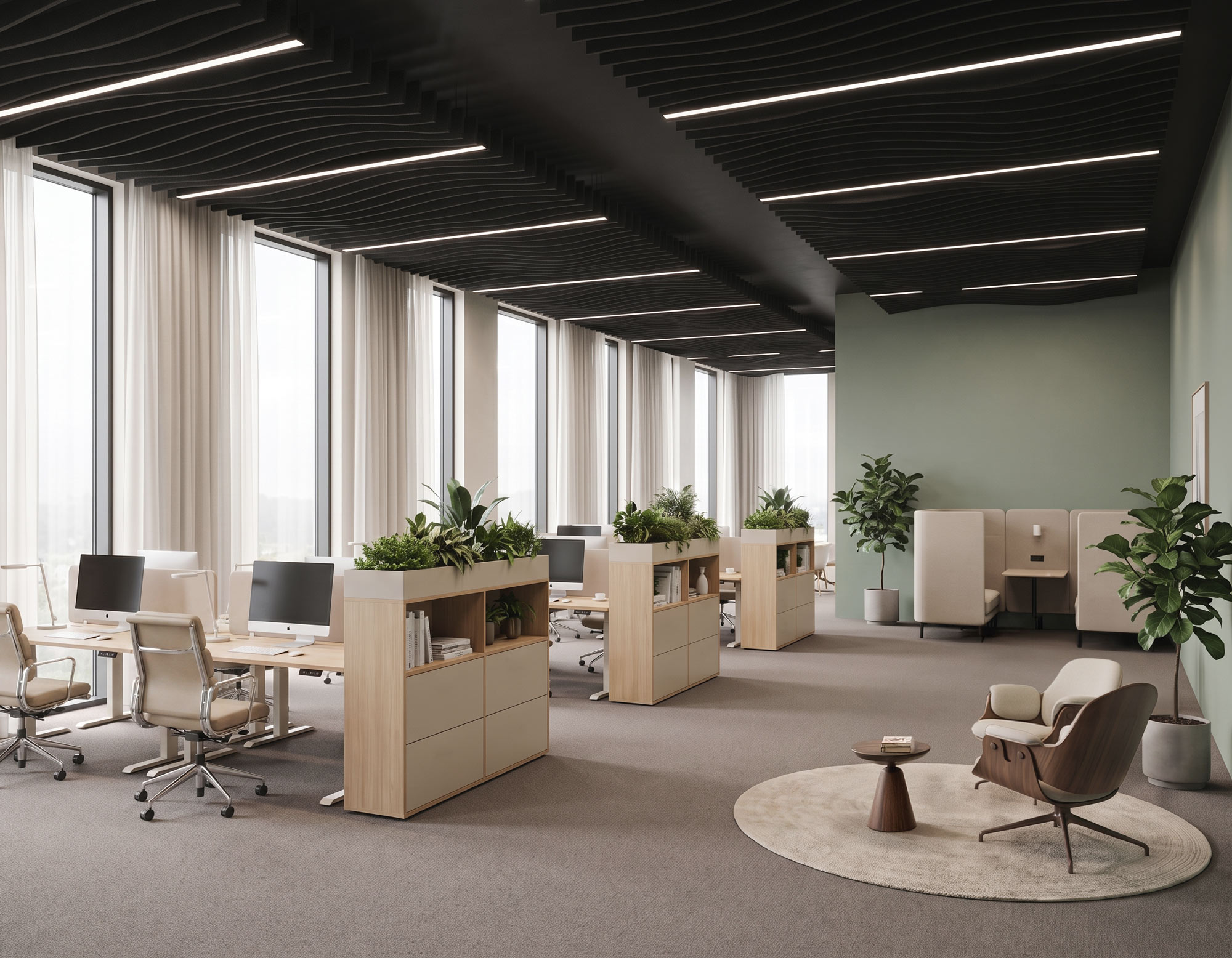
Equally important is the size of individual workstation groups. Endless rows of desks without spatial division create a restless atmosphere and overwhelm the brain. Half-height storage units with integrated acoustic elements are ideal for structuring areas without losing their openness. Plants also make a valuable contribution. They not only improve the indoor climate but also deflect sound, absorb some of it, and create a more pleasant atmosphere.
Despite all these optimizations, one thing remains important: employees need places where they can completely withdraw. Protected spaces are necessary for a confidential phone call, a short break, or a demanding task. Room-within-a-room solutions such as phone booths or small retreat areas are therefore almost indispensable today.
Focus Zones
When people talk about focus zones, many immediately think of small, soundproofed individual booths. In my opinion, this isn’t necessary in most cases. What people really need for focused work is, above all, an environment with clear rules and as few distractions as possible.
The best example of this is the library. People have always gathered in libraries to study with focus. Not because everyone gets a private room, but because everyone respects the same rules. It’s quiet, and no one is unnecessarily disturbed.
This very principle can also be applied to modern work environments. A space with excellent acoustics, clearly defined rules of conduct, uncluttered sightlines, and a deliberately minimalist design often creates better conditions for focused work than numerous small individual cubicles. Why not try a space with a “no shoes policy”? This psychological trick alone changes how people behave in a room.
If you’d like to learn more about quiet zones, you can find a separate article here.
Collaboration Zones
The best ideas rarely emerge from working alone, because everyone views a problem through the lens of their own experiences. As a result, every idea initially has a certain degree of tunnel vision. Only when thoughts are shared, questioned, and further developed does true innovation emerge. That’s exactly why collaboration zones are more important today than ever before.
Unfortunately, they’re often confused with traditional conference rooms. Neat tables, perfectly aligned chairs, and sterile meeting rooms rarely foster creative thinking. They invite people to present decisions, but not to develop new ideas together. A good collaboration zone, therefore, can feel a bit unfinished.
Flexible furniture, writable walls, whiteboards, creative materials, and spaces that can be reconfigured again and again encourage playful thinking and experimentation. Creativity flourishes where people are allowed to try things out without everything having to be finished or “right” just yet.
Precisely because markets are changing ever more rapidly and innovation cycles are becoming ever shorter, such spaces are continuously gaining in importance. They create the conditions necessary to ensure that good ideas are not left to chance.
Work Lobby
In their book Work Spaces: Stories, Models, Visions, S. Wörwag and C. Reutlinger describe a fascinating place: the work lobby.
This refers to a space that is deliberately situated between the company and the public. A place where employees are not entirely among themselves, but where encounters with people from outside the company can take place.
One example of this can be found at ON in Zurich. On the ground floor is “Roots Kitchen,” a restaurant open to the public where employees and visitors mingle. It is precisely this intentional exchange that brings new perspectives into the company and sparks spontaneous conversations that might never have arisen within the company’s own walls.
That said, a work lobby doesn’t necessarily have to be a restaurant or café. What’s far more important is its function. It serves as the interface between the inside and the outside— between focused work and social life. As the name suggests, it can simply be a lobby—a place where people can and should work. However, incorporating a café or restaurant helps breathe life into the space.
Such spaces foster informal exchanges and regularly bring fresh ideas into the company. At the same time, they increase employee retention by strengthening social connections and create a corporate culture that feels more open and approachable.
Flexibility
As mentioned at the beginning, in addition to a functional and people-centered environment, other components are needed to keep employees motivated and efficient. This brings us to flexibility.
Flexibility is no longer just an added benefit. It’s a prerequisite for sustainable performance.
After all, life cannot be planned. People get sick. They sleep poorly. Children get sick on short notice. Family members need support. If we’re honest, we have very little control over most things in our lives. And that’s why, despite careful planning, no two days are alike. Our concentration, creativity, and energy fluctuate. That’s only human.
Companies that allow their employees flexibility within clearly defined parameters benefit from it in the long run. After all, those who can change their work location when the task changes, who are allowed to organize their own work hours to some extent, or who can consciously take a break now and then, often work with greater focus and sustained productivity than someone who sits in the office from exactly 8 to 5.
Flexibility strengthens resilience and loyalty to the company. And what more could an entrepreneur want than to retain their best employees?
Controlling employees doesn’t work anyway. People can be physically present while their minds are somewhere else entirely. What matters, therefore, is not whether someone is seen, but whether they are motivated.
When motivation, trust, and personal responsibility come together, a work culture emerges that goes far beyond traditional on-site models. And that’s how hybrid work suddenly becomes an accepted work model.
Hybrid Work
Even though many companies are currently trying to scale back hybrid work, I don’t believe this trend can be reversed. Hybrid work is here to stay. And in my view, that’s a positive development.
Yes, we’re still in a learning phase. Neither companies nor employees have found the perfect form of hybrid work yet. We still need experimentation, adjustments, and a willingness to critically question existing models. However, the advantages clearly outweigh the disadvantages.
Hybrid work enables a more equitable distribution of family responsibilities and thus contributes to more balanced and resilient employees. It allows many people to better align their workday with their personal circadian rhythms. Those who are particularly productive in the morning can make the most of that time. Those who need a break now and then can often schedule it more flexibly.
There is also another crucial factor: the time saved on commuting. In Switzerland in particular, many people spend several hours a day commuting to work—time that is neither productive nor restful. When part of this commute is eliminated, employees regain valuable time in their lives.
All these benefits lead to one common result: happier employees.
Employees who feel that they are trusted.
Employees who are allowed to take on responsibility and, as a result, feel valued.
In my experience, such people often feel a stronger connection to their company than employees whose presence is constantly monitored, because trust fosters loyalty, while control often achieves the opposite.
I like to compare this to interpersonal relationships. Those who try to constantly control their partner rarely achieve greater closeness. More often than not, the exact opposite happens.
Of course, there will also be people who take advantage of this freedom. However, these exceptions should not be used as a benchmark for everyone. The vast majority want to do good work. Those who build their corporate culture on mistrust of a few exceptions often lose the trust of the many dedicated employees.
Tools
Last but not least, you also need to equip your employees with the right tools. And by that, I don’t primarily mean software or hardware.
The most important tool is a voice.
People want to be heard. They want to be taken seriously and feel that their opinion makes a difference. A healthy corporate culture therefore thrives on two-way feedback. It’s not just managers who provide feedback to their teams, employees also give feedback to their managers.
Regular workshops, surveys, or open discussion sessions help identify early on what’s working and where there’s room for improvement. At the same time, they show employees that their perspective is valued.
Equally important is the opportunity for professional development.
People need to grow. They want to learn new things, try new things, and expand their skills. Companies should therefore actively encourage their employees to step outside their comfort zones from time to time.
In the short term, the comfort zone provides a sense of security. And there are many who claim they’d be happy to still be doing exactly the same job with exactly the same requirements even after 20 years. Perhaps they step outside their comfort zone in their personal lives; perhaps they’re just fooling themselves.
Studies, at least, suggest that staying in one’s comfort zone leads to dissatisfaction in the long run. New experiences not only foster personal growth but often also bring new ideas, fresh motivation, and greater satisfaction. Pride is a true catalyst for motivation.
And then there’s AI…
AI
If I had written this post two years ago, artificial intelligence probably wouldn’t have come up at all. Today, it would be impossible to talk about the future of work without including AI.
The current hype will die down over time. However, the technology itself will remain and will fundamentally change the way we work in the long run. That’s why, in my view, access to AI tools is part of the basic infrastructure of a modern company.
However, simply providing licenses isn’t enough. Employees must be actively encouraged to use these tools in their day-to-day work, to experiment with them, and to explore their capabilities.
Not only because AI can make many tasks more efficient, but also because it allows you to actively counter that fear.
Many people today view artificial intelligence with uncertainty. The fear of being replaced or left behind is a common concern. However, those who use AI regularly develop an understanding of its strengths while also recognizing its limitations.
And then uncertainty turns into competence. And competence leads to self-confidence.
That is precisely why AI should be understood not as a threat, but as a tool. Just as computers and the internet have transformed our work, artificial intelligence will also become a natural part of our daily professional lives.
Companies that support their employees on this journey are investing not only in technology, but above all in the future-readiness of their people.
Conclusion: Corporate culture as the most important tool for future viability.
The workplace of forward-thinking companies does not consist of ever more technology, ever more control, or ever more efficiency.
It consists of people.
People who identify with their company.
People who take responsibility and are allowed to act autonomously.
The physical environment plays an important role in this regard. When carefully planned, a work environment creates a space where employees can flourish and focus fully on their tasks.
A company’s mindset is at least as important.
Mission, vision, corporate culture, and corporate goals must all be aligned. Only when these elements are in harmony and only when leadership exemplifies these values, can a work environment emerge that is successful in the long term.
Ultimately, culture determines whether people enjoy coming to work, give their best, and work together to make a company successful.
If you’d like to find out where you stand today and what potential lies within your workplace, I’d be happy to guide you through the process. Send me an email or schedule a no-obligation introductory meeting. I look forward to getting to know you.
FAQ
What does the office of the future look like?
The office of the future is human-centric. It supports people in working in a focused, healthy, and flexible manner. Key elements include good acoustics, a variety of workspaces, well-planned zoning, and separate areas for focused work and collaboration. Furthermore, the office of the future focuses on continuous development and remains flexible enough to adapt to new ways of working and technologies.
Why is Office Design important?
An interior architect's expert eye recognizes the potential of a space. She can strategically highlight strengths and offset weaknesses. An experienced interior architect can plan the work environment to reduce stress, foster collaboration, and thereby boost employee satisfaction. She can help lay the groundwork for a strong corporate culture.
Is a modern office concept worth it?
Our environment has a strong influence on us and our behavior. Neglecting this has long-term, negative consequences. Poor lighting, monotonous workspaces, and bad acoustics impact productivity, sickness-related absences, and employee retention.
Investments in lighting, acoustics, and flexible workspaces therefore pay off in the long run through higher employee satisfaction.
Can AI replace office jobs?
Yes and no. Artificial intelligence will transform many work processes, and some roles may disappear entirely. However, it is far more likely that tasks will simply shift. Either way, AI does not replace corporate culture, interpersonal collaboration, or creativity.
Precisely because AI automates many digital tasks, spaces for exchange, innovation, and teamwork will become even more important in the future. Consequently, the office of the future will be less a place for purely knowledge-based work and increasingly a hub for interaction, collaboration, and identification with the company.