

Interior Architecture for Zurich and the surrounding area: How to plan your home correctly
What is Interior Architecture?
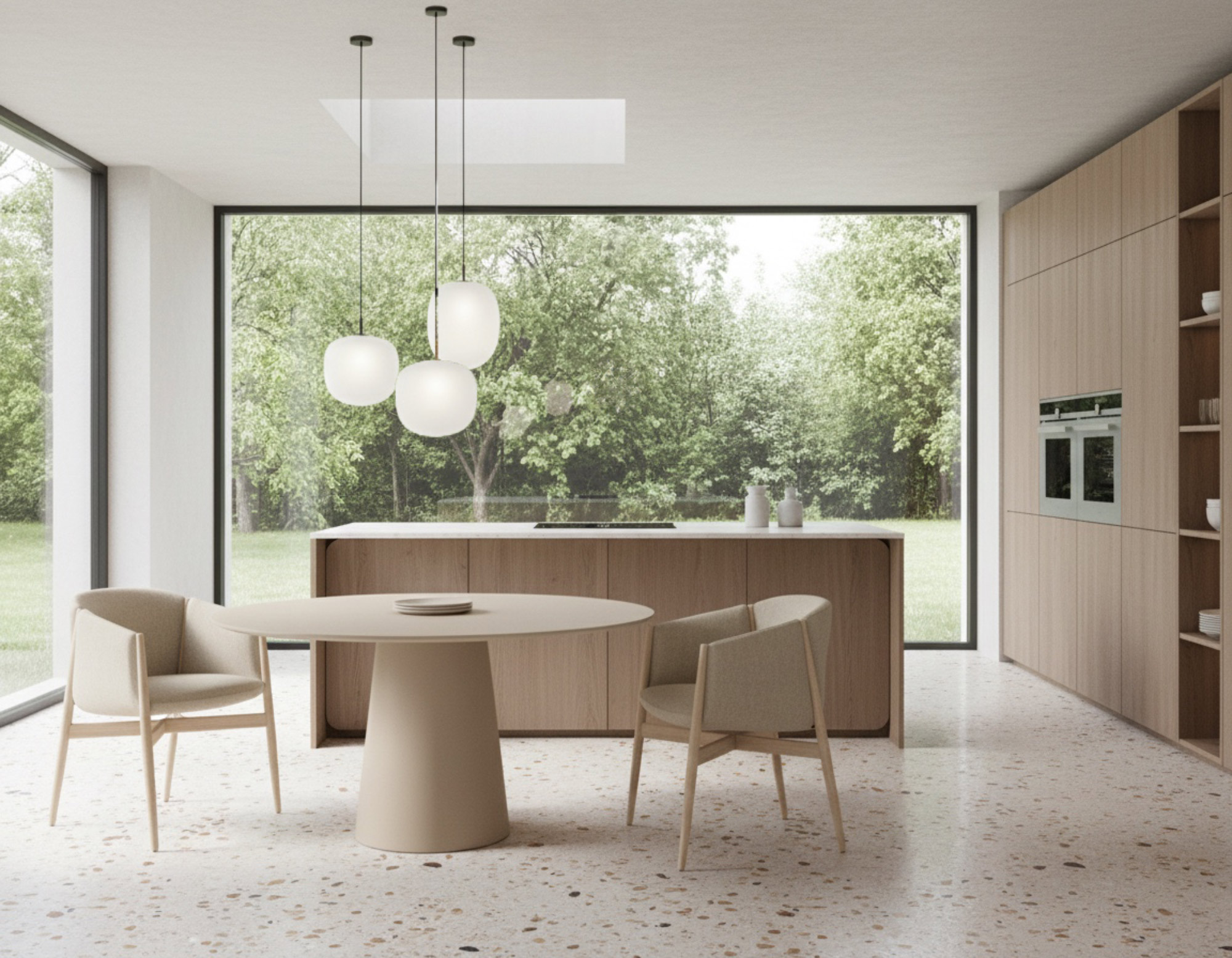
Ever since I began my interior architecture studies – which was more than 20 years ago now – I've often found myself in conversations where I have to explain to the other person what interior architecture actually means. Because the first reaction to mentioning my profession is usually: "Wow, that's great. I've always been interested in that. I love decorating my apartment." No, that's not interior architecture. That's the job of a decorator, a home stylist, or a home stager or of an interior designer.
Here in Switzerland, I personally draw a clear line between interior architecture and interior design, although I also regularly use the term "interior design," since it is actually the correct translation of "interior architecture" in English-speaking countries. However, a distinct profession has developed here. This is due to the numerous interior design degree programs that have emerged in recent years, awarding their graduates the title "Interior Designer"—even though the content of the training is more akin to that of a decorator. What these programs lack are the technical and structural components that constitute a complete interior architecture degree. This regularly leads to confusion in practice.
So what exactly is an interior architect? The word interior architecture contains architecture —a term that, in its broadest sense, refers to the craft-based, industrial, and digital design, as well as the aesthetic engagement of humans with built space. The planned design, creation, and construction of buildings form the core of architecture (source: Wikipedia). As an interior architect, I do precisely that, but primarily focused on interior spaces. This means that instead of simply fiddling with cushions and decorations, I plan the space holistically. I examine the construction and function of rooms, such as the structure of walls and ceilings. Furthermore, I also consider the human element within the space, their way of living and moving. With all these insights, I gradually develop strategic, well-considered, and logical solutions. Many claim that interior design is an artistic activity. However, this is a misconception. It is functional design that incorporates aesthetics and impact—whereas art is the result of a creative process that relies heavily on intuition (source: Wikipedia). Intuition and architecture don't go together; Our responsibility is simply too great for that.
As an interior architect, I am the architect of interior spaces. I oversee conversions and renovations from initial planning to completion. I can make rooms beautiful, yes. But I can also draw up installation plans for the electrician and plan the structural work. I understand materials and their processing, details, and constructive solutions. And I am skilled in holistic, interconnected thinking about the processes on the construction site.
That's interior architecture.
When it's Worth Hiring an Interior Architect
Not everyone who wants a new kitchen needs an interior architect. As long as you're making minimal structural changes and all the functions remain in place, it's perfectly fine to contact a trusted kitchen manufacturer or carpenter directly.
However, there are situations where the advice of an interior architect is worthwhile:
For larger house conversions or renovations
A renovation is always an intervention in the existing structure and therefore an opportunity.
However, many miss this opportunity because they focus only on the surface during renovations: new kitchen, new bathroom, new materials.
What is often missing is a view of the overall system.
- How do people move through the space?
- Where are unnecessary paths created?
- What works well and what doesn't?
- What features are missing?
- Where will I be in 10 years?
Especially in renovation projects in the city of Zurich, where existing building fabric is often adapted rather than newly constructed, the quality of the planning determines whether a project will work in the long term or not.
Often, such projects are undertaken independently or with companies specializing in construction. And yes, these companies know their craft and do an excellent job. However, they are not specialists in architecture: professionals trained to understand people in a space and to harmonize function with design. An interior architect considers space from different perspectives: she thinks in terms of relationships, connections, and the bigger picture.
In case of unclear or inefficient floor plans
Many apartments feel somehow difficult, without it being clear why.
Typical signs:
- Rooms don't feel "right"
- Furniture is difficult to place
- Processes feel cumbersome
Often, the root of the problem lies in the floor plan itself, in the arrangement and relationship of the rooms to one another. This is precisely where an interior architect is invaluable: She understands how spatial relationships function, how size, proportion, and light interact and influence each other. She is trained to see what often remains hidden to the layperson.
Overwhelmed by the planning process
A remodel or renovation, even a single new bathroom, can be extremely stressful. Even with smaller projects, the number of decisions to be made quickly adds up to a level that makes it difficult to maintain an overview:
- Materials: from wall coverings to cabinet handles – countless individual decisions that must harmonize.
- Colors: It's not just about choosing individual shades, but about coordinating all the colors and combining them into a cohesive overall look.
- Budget: As a layperson, it's virtually impossible to think of all the small details that affect costs.
- Priorities and schedule: Who does what – and when? Coordinating the companies involved without knowledge of the construction process is a giant task.
Of course, such a project can be managed without a professional, but the price is high. You have to grapple with every single decision, research each topic beforehand, acquire the necessary knowledge, build your own structure to keep track of everything, and much more. Anyone who takes this on needs time, patience, and a lot of energy. And those who make the wrong decisions often feel the consequences long afterward.
When spaces don't fit everyday life
This aspect is particularly important to me at lisannco. As an interior architect, I have the opportunity to create a home for my clients where they are not only satisfied, but where they can truly flourish. Because even though interior architects are trained to combine spaces and user needs, many in practice only scratch the surface of what's possible. I like to delve deeper.
I'm convinced that developing a truly effective concept requires more than just a brief consultation. That's why I enjoy getting to know my clients and asking them questions they wouldn't normally think to ask. Our spaces often reflect our personalities, and just as we shape the look of our rooms, these rooms can also shape us.
Some examples include:
- Organizational systems:A well-thought-out, functional organizational system can help even the most disorganized person achieve more structure, leading to greater peace and tranquility in their daily life.
- Visibility of elements:What we see and what we consciously conceal influences our daily routines far more than we realize.
- Zoning:A clever room layout can contribute to more energy, focus, and a more conscious experience of one's home.
The Most Common Challenges in Projects
Many problems arise not from a lack of ideas, but from a lack of understanding of the function, processes, and implementation.
Too Many Decisions at Once
An interior architecture project is a complex process. Trying to decide everything at once without a clear structure quickly leads to losing track.
This often results in:
- Inconsistent solutions
- Unnecessary costs
- Decisions that later need to be revised
Focus on Details Instead of the Big Picture
Often, people get bogged down in a single detail and make all further decisions dependent on it. This is dangerous for both the schedule and the budget. Losing sight of the big picture can quickly cause a project to spiral out of control. Therefore, an interior architecture project is always structured into logical sub-processes that work step-by-step from the overall concept to the details, and not the other way around.
Uncertainty About the Budget
Without experience, it is simply impossible to get a realistic picture of the expected costs. Many people start a project without really knowing what to expect financially. Obtaining quotes without a thorough understanding of the tender specifications can lead to cost estimates that are far from realistic. Not only are miscalculations frequently made because the type of work or construction wasn't described precisely enough, but many items are simply forgotten because the scope and processes of the work exceed the layperson's knowledge.
Missing connection between function and design
This is precisely where the real difference between decoration and interior architecture becomes apparent. Anyone who believes that a beautiful room is automatically a good room is mistaken. The brain adapts surprisingly quickly to the aesthetics of a room. However, a wardrobe that looks great but is impractical in everyday life will still be a source of frustration years later. And frustration in one's own home is a source of stress that is simply unnecessary.
Lack of clarity regarding processes
The execution phase is characterized by tight deadlines – this is the most exciting, but also the most stressful time of a project. Anyone who loses track of things here risks costly change orders. It's essential to know when which tasks need to be completed: Does the flooring come first, or the kitchen units? When are the joints filled? Does the painter come before or after the carpenter? There aren't always fixed rules. Individual projects sometimes require individual procedures. That's why experience and attention to detail are so important for making the right decisions in such situations.
How an Interior Architecture Project Works
A structured approach is crucial for the quality of the result.
At lisannco, I've developed my own framework, which all my projects follow. It's based on the phases of SIA 112 – the Swiss standard that architects in this country use as a guideline – and divides these phases into logical packages.
This framework is called FRAME.
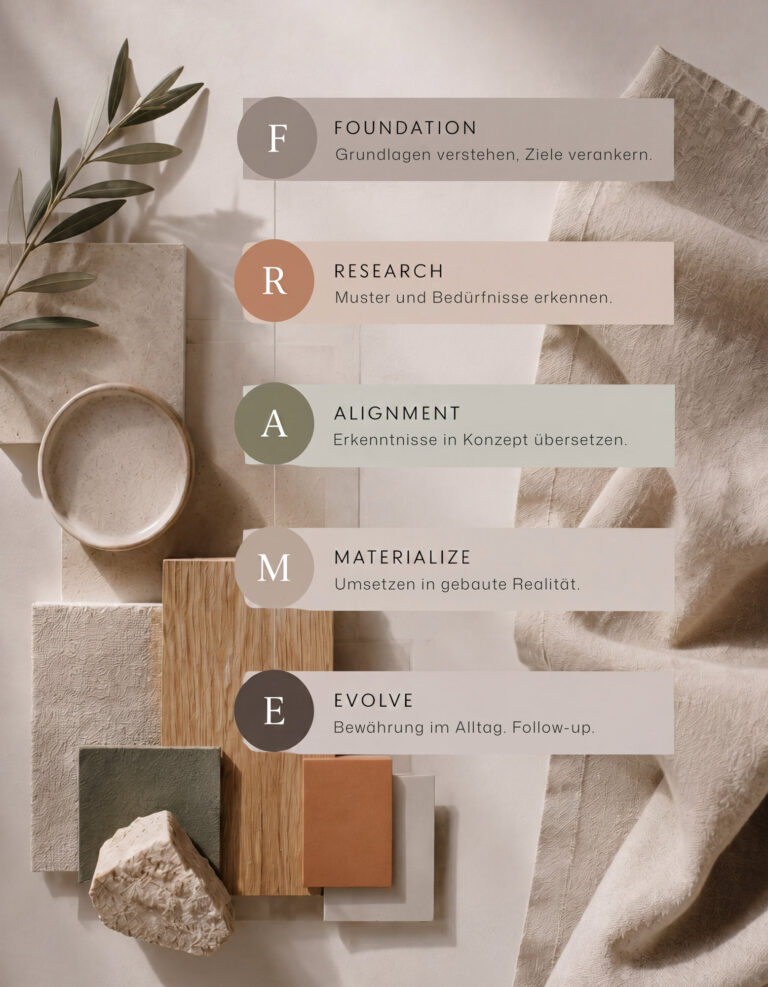
F – Foundation
Laying the foundation for collaboration
- Understanding goals, context, and constraints
- Clarifying scope, priorities and expectations
- Creating a solid base for all further decisions
The starting point that creates clarity about scope, priorities, and the next steps.
R – Research
It's not about the space, but about the people.
- Analyse how spaces are actually used
- Identifying friction points, patterns and behaviours
- Translating needs that are often not explicitly expressed
This phase is often underestimated, but it forms the basis for the quality and sustainability of the project.
A – Alignment
Based on the analysis, an overarching concept is developed.
- Developing a concept rooted in real needs
- Aligning function, atmosphere and identity
- Creating clarity across all spatial decisions
A good concept prevents decisions from becoming arbitrary later on.
M – Materialize
Here, the concept becomes built reality. This phase is very extensive and encompasses SIA phases 3 to 5 (project planning, detailed design, and construction).
- Floor plan optimization
- Lighting concept
- Material concept
- Furniture
- Ensuring quality through precise implementation
The best planning is of little use if it isn't implemented flawlessly.
Coordination, communication, and attention to detail are crucial.
The result is an environment that reflects the concept in every detail.
E – Evolve
lisannco places great value on strong customer relationships. Your home should continue to meet your needs for years to come.
If changes are needed, we intervene again to ensure a sustainable solution.
Floor Plan, Light, and Materials – The Most Important Factors
Interior architecture is always an interplay of many components. Nevertheless, there are three elements that have a particularly strong influence and that I would like to examine more closely.
Floor plan – the structure
The floor plan is arguably the most important factor in a building. It determines how we move around, where we spend our time, and how intuitively a space functions. It describes the relationships between rooms and is a measure of usability, comfort, and – through the arrangement of openings and walls – also our well-being.
A well-planned floor plan:
- reduces unnecessary travel
- creates clear zones
- improves space utilization
- integrates the surrounding environment
Especially in Zurich, where living space is often compact, a well-thought-out room layout is crucial.
Light – the underestimated well-being factor
Light influences far more than what is visible to the eye. It influences:
- our sleep-wake cycle
- our concentration
- our mood
Light-sensitive cells in the eye regulate certain hormones that directly affect our energy levels. Light is therefore not only a visual but also a biological factor. And this applies not only to natural light – artificial light also affects our biology. Therefore, careful planning is essential to incorporate biological processes into design considerations, promote positive effects, and avoid negative consequences.
Good lighting design takes into account:
- different light sources
- different uses of light
- the different times of day
I've described how light influences our everyday lives here .
Materials – Impact through the Senses
We often choose materials based on price, quality, and appearance. However, their impact goes far beyond that. In addition to the visual impression, materials also appeal to these senses:
- Haptics
- Temperature
- Acoustics
All the sensory impressions affect us and significantly influence our well-being – this isn't just an assumption, but scientifically proven. Perhaps you've already heard of biophilic design? This term describes the effect of materials and elements that connect us with nature – such as wood. Several scientific studies have shown that the use of wood has a calming effect on people and reduces stress.
If you'd like to learn more about biophilic design and related research areas, you can find more information here .
What Good Interior Architecture Can Achieve
A well-designed space isn't just visually appealing—it influences the behavior of the people in it.
Habits
James Clearthe bestselling author of Atomic Habits, puts it perfectly: Our habits change depending on the space we're in and the cues surrounding us.
- Visibility Influences Usage
- Paths Influence Decisions
- Structure Influences Routines
The key insight here is that a well-designed space not only supports existing routines—it can help establish new ones and thus further develop one's personality.
You can read more about how spaces influence habits here .
Decisions
A well-planned space reduces complexity through a functioning organizational system and clear processes. All the small micro-decisions of everyday life become unnecessary when everything has its place and every action follows a sequence. This significantly reduces the burden on daily life because the mental load is noticeably lowered.
Energy and Well-being
When used wisely, interior architecture can create spaces that help you recharge and boost your well-being. Crucially, user needs are discussed thoroughly, not just superficially, both before and during the design phase. As an interior architect, understanding how you perceive your surroundings, your sensitivity, what drains your energy and what energizes you allows me to make conscious design choices that specifically influence your experience of the spaces. I can create retreats where you can truly unwind and utilize materials, colors, and textures that stimulate your system in the right measure, without overwhelming you. This is why it's so important to me to truly get to know my clients and understand them as individuals.
Why spaces have such a strong influence on our well-being is explained here in more detail.
How Much Does Interior Architecture Cost in Zurich?
Most interior architects and designers charge by the hour. I've seen rates ranging from CHF 100 to CHF 300 per hour. However, you shouldn't choose solely based on price. The most important thing is that it is a good personal fit, because an interior architecture project is also a personal matter. It's also worth checking whether the work methods and experience of your prospect match your expectations.
The total cost of a project varies considerably and depends on several factors:
- Project size
- Complexity
- Scope of work
Feel free to request my hourly rate without obligation. I generally charge fixed prices for the initial phases up to the final concept. From the project planning stage onward, I bill on a time and materials basis and invoice at the end of each month or every two months.
How to Find the Right Interior Architect in Zurich
Personally, I believe that the most important factor is whether you click on a personal level. Larger renovations often take more than a year from planning to completion and are very personal. If the foundation isn't right and conflicts keep arising, the project's success is seriously jeopardized.
Understanding Your Daily Life
A good interior architect listens to you and asks questions about your life and habits. They regularly seek communication to learn more about you, clarify any questions, and build trust. Someone who only asks about your Pinterest board and your favorite colors might not be the right person for you.
A Clear Process
An architecture project is complex. If your interior architect simply starts without structure and you don't know what's coming next, it quickly leads to frustration. Look for professionals with a clearly defined process – like my FRAME process. This gives you peace of mind and lets you sleep soundly at night.
Communication
Here, the saying "silence is golden" doesn't apply. Clear communication, transparency, and a sense of responsibility ensure that your project doesn't end in chaos. Regular exchange and timely feedback are essential foundations for trust and a sign of mutual respect.
Conclusion: Why Thoughtful Planning is Worthwhile
Interior architecture isn't about luxury, but about quality in everyday life. Well-planned living spaces make your daily routine easier and enrich your life. Especially in our fast-paced times, it's important to consciously design your home to reduce stress and promote regeneration.
Hiring an interior architect isn't a nice-to-have, but an investment in a sustainable home. Particularly in an environment like Zurich, where space is often limited and existing structures are frequently outdated, it becomes clear how crucial well-thought-out solutions can be.
If you want to not only design your home, but truly understand and optimize it, a holistic view of the space is worthwhile.
I would be happy to support you in planning your rooms so that they function effectively in the long term and make your daily life easier.
Learn more about working together here.
FAQ
What is the difference between an Interior Architect and a Interior Decorator?
An Interior Architect plans and coordinates structural changes to interior spaces, from the initial concept sketch and material selection to technical planning and construction management. Unlike mere decoration, interior architecture combines a deep understanding of construction with aesthetics. The goal is a holistic design that optimizes spaces functionally, emotionally, and economically.
How much does an Interior Architect cost in Zurich?
Interior designers in Zurich typically charge hourly rates, averaging between CHF 125 and CHF 200 per hour,though rates for well-known designers can be higher. Alternatively, fixed prices are available for clearly defined project phases; for example, I offer selected package deals for small-scale projects in my information brochure. For large renovation projects, fees are often calculated as a percentage of the total construction cost, based on the official fee schedules of the SIA (Swiss Society of Engineers and Architects).
How do you find a qualified Interior Architect in Zurich and the surrounding area?
A qualified Interior Architect is primarily distinguished by a solid, full-time degree from a university of applied sciences (such as HSLU in Switzerland) or by many years of demonstrable project experience. While memberships in professional associations like VSI.ASAI or SIA can be an additional mark of quality, these titles are fee-based, which is why many experienced professionals don't necessarily hold one of these certifications. When choosing a designer, focus primarily on a compelling portfolio, experience, and a good rapport during the initial consultation to ensure the necessary technical and design expertise for your project.